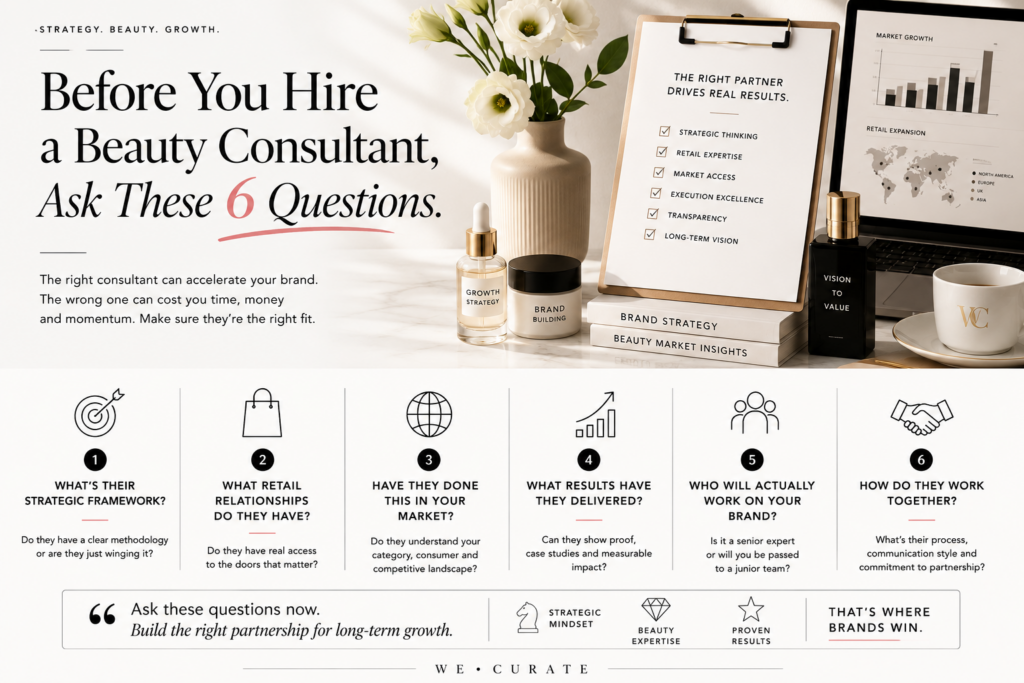
Before You Hire a Beauty Consultant, Ask These 6 Questions
I have been on both sides of this conversation. I have hired consultants as an executive at Christian Louboutin Beauty and NEST NEW YORK. I am a beauty brand consultant. What I know from both positions is this: most founders choose badly — not because they are not smart, but because they do not know what questions to ask before signing.
A good consulting engagement changes the trajectory of a brand. A bad one costs money, time, and momentum you cannot get back. Here are the six questions that separate the two outcomes.
Question 1: Have You Done This Specific Thing Before?
Not “have you worked in beauty” — everyone has worked in beauty. The question is whether they have done the exact thing you are asking them to do.
Have they launched a brand at Space NK from scratch? Have they managed a US market entry for a European brand with no existing presence? Have they negotiated a distribution agreement with Sephora on behalf of a brand that had no track record?
General category experience is not the same as specific execution experience. Press them for precise examples that map to your actual situation. Vague answers — “I have extensive experience in premium retail” — are a signal that the specific experience may not exist.
Question 2: When Did You Last Speak to the Buyers You Are Promising to Introduce Me To?
Retail relationships have a shelf life. A buyer contact from five years ago is not a relationship. It is a memory.
The consultants who will actually open doors for you are the ones who stayed in the conversation — who attended the trade events, made the introductions that went nowhere graciously, and kept in touch even when there was nothing immediate to sell. That kind of relationship gets a call returned. The other kind does not.
Ask specifically: when did you last have a substantive conversation with a buyer at the retailers relevant to my brand? A confident, specific answer is what you want. Hesitation or generalisation is what you should be wary of.
Why this matters more than you think
I have watched founders pay significant retainers to consultants who promised Sephora access — only to discover six months later that the buyer had moved on, the relationship was dormant, and the introduction was never going to happen. Ask the question early. It will save you a great deal of disappointment.
Question 3: Can I Speak to a Founder You Have Worked With in the Last 12 Months?
Written testimonials on a website prove nothing. Anyone can curate a quote. What matters is a real conversation with a real founder who worked with this consultant on a project similar to yours — recently enough that the experience is still fresh and the results are visible.
A consultant who hesitates on this question, offers only older references, or provides contacts who cannot speak to your specific use case is telling you something important about either their recent track record or their client relationships.
A good beauty brand consultant will offer references proactively. It is a sign of confidence and transparency — both of which you need in a working relationship.
Question 4: What Will You Not Do?
This is my favourite question to ask and to be asked.
Consultants who claim to do everything — strategy, retail, marketing, digital, PR, product development, investor relations — are lying to you, even if unintentionally. No one is genuinely excellent across all of these. The best consultants are clear about their edges: where their expertise ends and where you will need someone else.
Knowing your limits is a sign of real expertise. It is also a sign of the kind of honesty you want in someone advising your business. If a consultant cannot answer this question with specificity, they are selling you breadth rather than depth. Breadth is rarely what a scaling beauty brand actually needs.
What the answer should sound like
Something like: “I focus on market entry strategy and retail partnerships. I do not do brand design or digital advertising. For those you will need specialists.” That answer tells you they know exactly what they are selling you — and they are not going to waste your money pretending otherwise.
Question 5: What Does Success Look Like at 6 Months?
If a consultant cannot define measurable outcomes before starting the engagement, walk away.
Good consulting is not “I will provide strategic guidance and monthly recommendations.” It is: at six months, you will have a validated distribution strategy for the UK market, introductions to three qualified retail buyers, and a revised pricing architecture that supports prestige positioning. Specific. Measurable. Accountable.
The absence of specificity is not modesty. It is a signal that the consultant either does not know what they will deliver, or does not want to be held to anything. Neither is acceptable when you are writing a monthly cheque.
Question 6: How Do You Charge — and What Exactly Does That Include?
Consulting engagement structures vary enormously. Day rates, monthly retainers, project fees, success fees — and the difference in what each actually includes is significant.
A monthly retainer that means “available for calls when you need me” is very different from one that includes a weekly deliverable, attendance at buyer meetings, and a defined number of contact hours. A project fee that excludes travel, introductions, and follow-up work can quickly become two or three times the quoted number.
Get the scope in writing before you sign. Not as a formality — as a genuine tool for managing the relationship. It protects both sides and sets the expectations that determine whether the engagement feels like value or like disappointment.
The Red Flags No One Tells You About
They pitch before they listen
A first meeting should be mostly questions. If a consultant spends the first thirty minutes presenting their methodology before they have understood your brand, your market, or your actual challenge — they are selling, not consulting. The two are very different things.
Their US experience is theoretical
I see this constantly. European consultants — often with impressive UK credentials — advising on the US market from London or Paris. The US beauty landscape is structurally different: the retail mechanics, the regulatory environment (FDA compliance is not a footnote), the consumer psychology, the influencer ecosystem. If your consultant has not physically operated in the US market, they cannot guide you through it. They can describe it from the outside, which is not the same thing.
They promise outcomes they cannot control
No consultant can guarantee a Sephora listing. No consultant can promise a specific revenue number. What they can commit to is the quality of work, the introductions they will make, and the strategic clarity they will create. Anyone who guarantees specific outcomes they do not control is either naive about how the industry works or not being straight with you.
One Last Thing
The best consulting relationships are not transactions. They are partnerships — built on shared standards, direct communication, and mutual accountability. You are not just hiring a beauty brand consultant for their knowledge. You are hiring them for their judgement, their network, and their willingness to tell you the truth when the truth is uncomfortable.
That is the only kind of consulting worth paying for. At We-Curate, it is the only kind we offer.
Frequently Asked Questions
Look for specific execution experience that matches your challenge, current retail relationships (not historical ones), recent and verifiable client references, clearly defined scope, and measurable outcomes agreed before the engagement starts. Avoid consultants who claim expertise in everything or cannot answer what they will not do.
Senior beauty brand consultants typically charge between £3,000 and £15,000 per month on retainer, or £5,000 to £30,000 for defined project scopes. The variation depends on seniority, scope, and whether the engagement includes execution support alongside strategy. Always clarify exactly what is included before signing.
When you have a specific, defined challenge — a market to enter, a retail target to reach, an investment round to prepare for. Hiring before you have clarity on what you need often results in expensive strategy work that does not translate into action. The brief matters as much as the consultant.
Ask directly when they last had a substantive conversation with buyers at the retailers relevant to your brand. A specific, confident answer signals a live relationship. Hesitation or vague references to past roles are a warning sign. Retail relationships require ongoing maintenance — a contact from five years ago is not a relationship.