
Entering the UK Beauty Market: What Most Brands Get Wrong
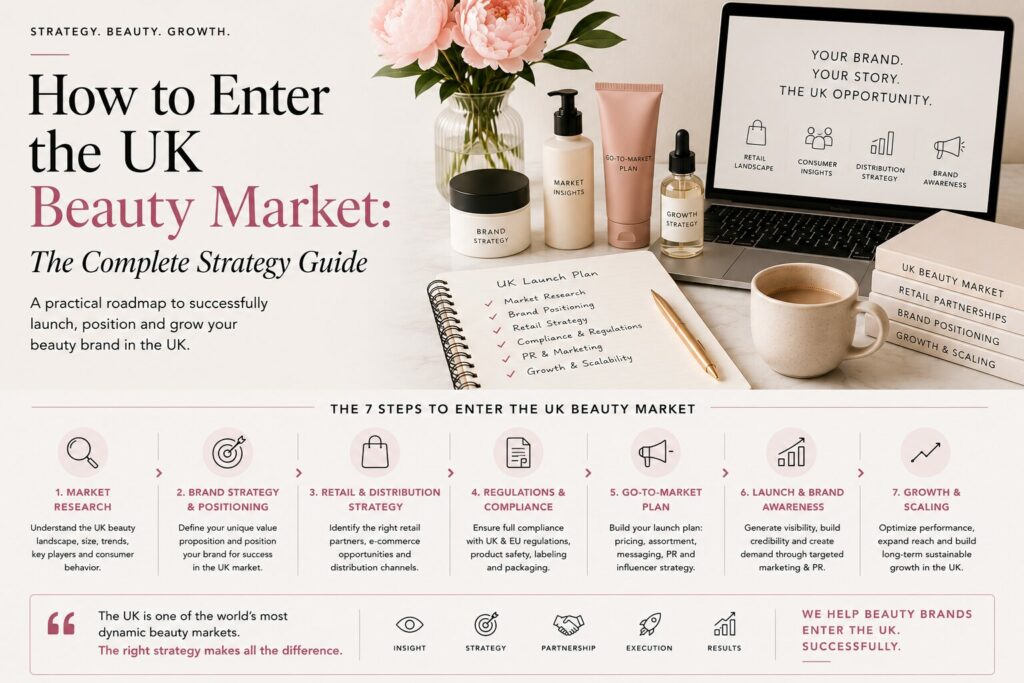
How to Enter the UK Beauty Market: The Complete Strategy Guide
By Virginie, Founder & CEO at We-Curate.
I have watched more UK launches fail from good brands than from bad ones. That is the part people find hard to believe.
The products were right. The founders were serious. The money was there. What went wrong was almost always the same thing: they treated the UK as the easy market. The one you do after France, before America. The soft landing.
It is not. Since Brexit it is a separate country in every sense that matters commercially, and the brands that discover this late pay for it in months, not euros.
Here are the five things that decide whether a UK entry works.
1. Regulation is a strategic constraint, not paperwork
Your EU compliance does not transfer. Great Britain runs its own cosmetics regulation, its own notification portal, and it requires a Responsible Person established in the UK before a single product can be sold. Their name and address must appear on your packaging.
For most European brands that means a label redesign they did not budget for, and a compliance process that runs three to six months.
I have seen a brand lose an entire Christmas window to this. Not because anyone was careless. Because nobody told them it was a separate track that had to start first.
2. The retail landscape is concentrated, and the first door defines you
The UK does not work like the US. There is no long tail of channels to experiment in. A small number of retailers control prestige beauty, and each one carries a position that attaches itself to your brand.
Space NK says one thing about you. Liberty says another. Boots says something else entirely, and it is not a place to test.
The mistake I see most often is not failing to get a listing. It is getting the wrong one, early, because it was the one that said yes. That is very difficult to undo.
3. Your pricing model has to be rebuilt, not converted
UK retail pricing is not your European RRP at the exchange rate. VAT sits inside the consumer price. Retailer margin in prestige is heavier than most brands assume. Post-Brexit duty and clearance are real costs now, not rounding errors. Promotional participation is expected and it comes out of your margin.
Build the number from the bottom up. Then look at who you will sit next to on shelf and ask honestly whether a British consumer, who is more price-aware than an American one, will choose you at that price with your current level of awareness.
Usually the answer changes the plan.
4. Editorial still moves retail here
This surprises people. In a market this digital, the beauty press still carries commercial weight, and UK buyers read it. A strong editorial run genuinely improves a retail conversation.
But print works three to five months ahead. If you are launching in September and starting outreach in August, you have already missed it.
The creator market is a separate discipline. UK beauty creators have been monetising for over a decade. Gifting alone does very little. That is a budget line, not a favour.
5. You cannot run the UK from Paris
This is the one I feel most strongly about.
The UK is a relationship market. Buyers want someone they can meet. Editors want someone who turns up. Distributors behave differently when there is a person accountable in the country.
Brands that put UK-based or fractional leadership in place consistently outperform those managing it remotely, and it is rarely close. Not because the strategy was better. Because someone was there when the market moved.
What this actually looks like in practice
Every one of these five points has a layer underneath it that decides the outcome: which Responsible Person structure suits your model, which retailer to approach in what order and with what story, what your price architecture needs to be to survive a promotional calendar, who to brief and when.
That is the work. It is specific to your brand, your category and your stage, and it is not something a guide can answer for you.
We-Curate operates from London and Paris. We have taken luxury and lifestyle brands through UK entry end to end, and we stay in the business until the numbers are there.
If you are looking at the UK in the next twelve months, the most useful thing you can do is have the conversation before you commit to a launch date.
Related reading: How to Launch a Beauty Brand in the US · UK vs US Beauty Market · Beauty Retail Strategy: Sephora, Space NK and Liberty