
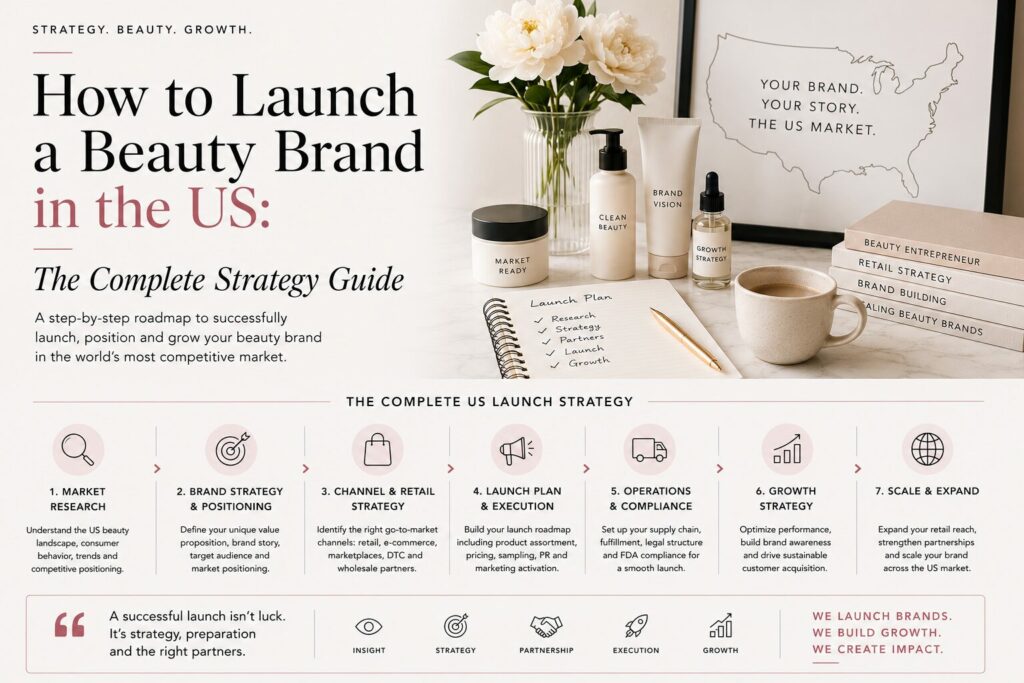
How to Launch a Beauty Brand in the US: The Complete Strategy Guide
Launching a beauty brand in the US takes 12 to 18 months from strategy to a meaningful retail presence, and a realistic minimum budget of £150,000 to £300,000 over the first 18 months, excluding product costs. The US beauty market is worth over $100 billion a year. It is the market where trends are set, where brands become global, and where a single successful retail listing can change a company’s trajectory. It is also one of the hardest to enter. Every year, dozens of European and international beauty brands attempt a US launch. Most underestimate the timeline, the cost and the structural differences with their home market. Many stall; some fail entirely.
This guide is the one we wish every brand had read before calling us. It covers the six steps of a US launch: understanding the market, FDA compliance, positioning and pricing, the route to market, PR and creators, and operations, followed by the five mistakes that most often derail excellent brands.
- US beauty sales reached a record $50.6 billion in the first half of 2025 alone.
- Since the Modernization of Cosmetics Regulation Act (MoCRA), every brand must list its products with the FDA and report serious adverse events within 15 business days (FDA).
- Claims such as SPF or anti-acne make a product an over-the-counter drug in the US, with a much stricter regulatory pathway.
- A product at £45 in the UK often needs to retail at $65 to $75 in the US, not $55.
- For most luxury and lifestyle brands, we recommend a hybrid route: DTC and targeted retail in parallel, led by fractional US leadership.
Step 1: How is the US beauty market different from Europe?
The US is not Europe with a bigger population. It differs in three ways that shape every launch decision: its shoppers, its retail landscape and the weight of direct-to-consumer (DTC) sales. The scale is also different: US beauty sales reached a record $50.6 billion in the first half of 2025, according to WWD reporting we analysed in our review of US beauty sales, compared with a UK market worth around £30 billion a year. Our UK vs US beauty market guide compares the two in detail.
The American beauty shopper
American beauty shoppers are sophisticated, know their ingredients, and are heavily influenced by peer recommendations, editorial press and social proof. They respond well to efficacy claims, clinical backing and storytelling, and they are deeply loyal to brands that earn their trust. A brand’s origin, such as French pharmacy, British luxury or Korean innovation, can be a powerful asset if it is positioned deliberately.
A fragmented retail landscape
In the UK, a handful of retailers such as Space NK, Boots, Selfridges and Harvey Nichols cover most of the prestige market. The US is fragmented, and each channel has its own requirements, margins and shoppers:
| Channel | Main retailers | Best suited to |
|---|---|---|
| Mass-prestige chains | Sephora, Ulta | Prestige and trend-led brands |
| Department stores | Nordstrom, Neiman Marcus, Saks | Luxury brands |
| Clean beauty specialists | Credo, Follain | Clean and natural brands with substantiated claims |
| Specialist independents | Bluemercury | Premium skin care and niche brands |
| DTC | The brand’s own US website | All brands, as the base for retail conversations |
The DTC opportunity
The US has the most developed DTC beauty market in the world. American shoppers are comfortable buying beauty online from brands they discover through editorial, creator content or paid social. A strong DTC presence is not optional: it produces the sales data and brand awareness that make retail conversations credible.
Step 2: What FDA rules must a beauty brand meet before launching in the US?
Treat FDA compliance as a strategic constraint, not an administrative formality. This is where many European brands get their US launch wrong: they discover too late that a claim, an ingredient or a label blocks the sale. Allow 3 to 6 months for compliance, and do it before any retail conversation.
Cosmetic or over-the-counter drug?
The FDA draws a sharp line between cosmetics, which change appearance, and drugs, which affect the body’s function. Many claims that are standard in European marketing, such as SPF, anti-acne or anti-dandruff, make a product an over-the-counter (OTC) drug in the US. The FDA regulates sunscreens as OTC drugs, which must meet drug safety and effectiveness standards. Get the classification wrong and you cannot legally sell the product.
Ingredients
The US restricts far fewer cosmetic ingredients than the EU, but the ones it does restrict include some that are common in European formulas. Audit your full range against the FDA’s list of prohibited and restricted ingredients before any US activity begins.
Labels
US labels differ from EU labels in format and content. Net quantity must appear in both metric and US customary units, and ingredient lists follow INCI names with US formatting rules. Under MoCRA, labels must also give contact details for reporting adverse events. Budget for a label redesign.
MoCRA: the new rules
The Modernization of Cosmetics Regulation Act of 2022 was the biggest update to US cosmetics regulation in decades. According to the FDA, it requires brands and manufacturers to:
-
- register manufacturing and processing facilities with the FDA, and renew the registration every two years
-
- list every cosmetic product sold in the US, with its ingredients, and update the listing every year
-
- report serious adverse events to the FDA within 15 business days
-
- keep records showing that each product’s safety is adequately substantiated
The FDA can also now order a mandatory recall when a product poses a serious health risk. Rules on fragrance allergen labelling and good manufacturing practices are still being developed. Work with a US regulatory specialist before launch: in our US launch case study, a European skincare brand blocked by missing compliance reached full FDA compliance in 8 weeks once the work was properly organised.
Step 3: How should you position and price a beauty brand for the US?
Your home-market positioning may not translate directly. American shoppers have different cultural references and a different competitive landscape, so three elements usually need rework: the origin story, the claims and the price.
Reframe your origin story
European heritage can be a powerful asset in the US, but it must be framed deliberately. “Made in France” resonates differently in beauty than “Made in Germany”. “British luxury” has specific connotations. “Scandinavian clean beauty” is a strong category signal. Decide how your origin plays in the US and build it into your positioning. If the identity itself needs to change, a market launch is often the right moment: see brand identity and rebranding.
Adapt your claims
US shoppers respond to efficacy-led claims, clinical data and ingredient hero stories. They are also increasingly alert to greenwashing: “clean” and “natural” claims must be substantiated, not asserted. Audit your marketing claims for US appeal and FDA compliance at the same time.
Price for the US, not with an exchange rate
US retail pricing is not your home price converted. US prestige retailers expect a margin of around 50% to 55%, and your price must also cover import duties, freight, warehousing, sales tax handling and, if you use one, a distributor’s margin, while still landing at a price that is credible for your positioning. In practice, a product at £45 in the UK often needs to retail at $65 to $75 in the US, not the $55 a conversion gives. Tariff uncertainty following recent US trade policy changes makes careful modelling even more important. Our beauty pricing strategy guide explains how to build the price.
Step 4: Which route to market should you choose for the US?
There is no single right route. The best one depends on your positioning, budget, category and stage. There are four main models:
| Model | How it works | Cost and speed | Best for |
|---|---|---|---|
| A. DTC first | A US online store, paid social, PR and creators; DTC sales become proof of demand for retailers | Lower upfront cost, slower build, strong data | Brands with a strong digital story and engaged social following |
| B. Anchor retailer first | One anchor listing (Sephora, Credo, Nordstrom) as the entry point, then wider distribution | Higher barrier to entry, faster credibility | Brands with strong retail relationships and proven sell-through |
| C. Distributor-led | A US distributor manages retailers, warehousing and sales | Lower resource need, lower margin and less control | Brands needing a lean entry without a US team |
| D. Hybrid (our recommendation) | DTC and brand awareness in parallel with targeted retail, led by fractional US leadership | Balanced cost, builds equity and sales together | Most luxury and lifestyle brands |
If you choose a distributor, choose very carefully: a bad distributor can damage your positioning permanently. If you choose a retailer first, choose the right one, not the biggest. A Sephora listing is meaningless if the brand cannot support it with marketing and sell-through, and most brands that get listed are delisted within 18 months. Our guide how to get into Sephora, Space NK and Liberty explains what buyers expect, including margins of 45% to 65% in prestige beauty.
The hybrid model relies on fractional leadership: a senior fractional CMO or fractional COO who owns the US market without the cost of a full US team.
Step 5: How do PR and creators work in the US beauty market?
US beauty press and creator culture work differently from the UK and Europe. Four rules matter most:
-
- Lead times are longer. Major US beauty editors work 3 to 6 months ahead for print. Start press outreach well before launch.
-
- Gifting alone does not work. US creators expect payment or a genuine relationship. A targeted micro-creator strategy beats mass gifting.
-
- Editorial credibility drives retail. A feature in Allure, Vogue or Into The Gloss is worth more than almost any paid media for a prestige brand entering the market.
-
- Community matters. Reddit, TikTok and specialist beauty communities can make or break a brand faster than any traditional PR campaign.
These mentions also shape AI search: in an Ahrefs study of 75,000 brands, web mentions were the factor most correlated with visibility in Google’s AI Overviews. Our beauty PR page explains how to earn them, and brand communication covers adapting your voice to the US.
Step 6: What operations does a US beauty launch need?
Operational failure is the most common reason US launches stall after a promising start. Put these foundations in place before you go to market:
| Area | What you need | Why |
|---|---|---|
| Warehousing and fulfilment | A US-based third-party logistics partner (3PL) for DTC and retail orders | Shipping individual orders from Europe is not viable at scale |
| Legal entity and banking | A US company and bank account | Most major US retailers require one; it takes longer than expected |
| Import and customs | A customs broker experienced in cosmetics; HTS codes, duty rates and FDA entry processes understood | Avoids goods held at the border |
| Sales tax | An automated tool such as TaxJar or Avalara | US sales tax varies by state and applies from the first DTC sale |
Done well, this moves fast: in our skincare US launch case, US warehousing was operational in under 30 days, the brand launched with selected US retailers within the quarter, and retail sell-in exceeded forecast by 24% in the first two months.
How long does a US beauty launch take, and what does it cost?
A realistic timeline is 12 to 18 months from strategy to meaningful retail presence:
| Phase | Typical timing | Main work |
|---|---|---|
| Strategy and audit | First weeks | Market fit, route to market, pricing model, budget |
| Compliance and labels | 3 to 6 months | Claims, ingredients, labels, MoCRA registration and listing |
| Operations | In parallel | US entity, 3PL, customs broker, sales tax |
| Brand awareness and DTC | From launch onwards | US website, PR (3 to 6 months lead time), creators, community |
| Retail development | 12 to 18 months to a meaningful presence | Pitch preparation, first listings, in-store activation |
Budget realistically. At a minimum, plan for regulatory compliance (£5,000 to £20,000), label redesign, US logistics, initial marketing and PR, and fractional or full-time leadership. A realistic minimum budget for a credible US entry is £150,000 to £300,000 over the first 18 months, excluding product costs. The alternative is more expensive: a failed US launch can cost £50,000 to £200,000 in wasted stock, legal fees and lost retailer relationships, as we explain in How Much Does a Beauty Consultant Cost?
What are the 5 mistakes that sink US beauty launches?
After supporting several beauty brands through US market entry, these are the mistakes we see most often.
1. Launching too fast
Brands that skip compliance, launch without US logistics or pitch retailers before building awareness consistently underperform those that take 12 to 18 months to get the foundations right.
2. Underestimating the capital needed
Compliance, labels, logistics, marketing, PR and a US team all require real investment. Brands that enter with too little capital run out of runway before awareness is strong enough to drive sell-through.
3. Choosing the wrong first retailer
The goal is the right listing, not any listing. A poorly chosen first retailer can damage your positioning and make later retail conversations harder than having no US retail at all.
4. Keeping a UK or European brand voice
Tone, humour and cultural references that work in the UK often fall flat or read as cold in the US, where shoppers respond to warmth, inclusivity and authenticity. Reviewing your communication for US fit is a commercial necessity, not vanity.
5. No local leadership
Running a US launch from London or Paris, with no local presence and no one who owns the US strategy day to day, is the most common structural mistake we see. The US market moves fast and rewards brands that are present and responsive.
For a real example of what goes wrong, and how it was fixed, read our skincare US launch case study. For the broader picture, see US expansion for EU and UK brands.
Frequently asked questions
How long does it take to launch a beauty brand in the US?
A realistic timeline from strategy to meaningful retail presence is 12 to 18 months. This includes regulatory compliance (allow 3 to 6 months), label redesign, US logistics, brand awareness and retail pitch preparation.
How much does it cost to launch a beauty brand in the US?
A realistic minimum budget for a credible US market entry is £150,000 to £300,000 over the first 18 months, excluding product costs. Regulatory compliance alone typically costs £5,000 to £20,000.
What does MoCRA require from beauty brands?
MoCRA requires facility registration with the FDA (renewed every two years), a listing of every product and its ingredients (updated yearly), reporting of serious adverse events within 15 business days, and records supporting each product’s safety.
Do I need a US office to launch in the US?
Not necessarily at first, but you do need US-based operations such as warehousing and fulfilment, and ideally US-based or fractional leadership who owns the market day to day. A fractional CMO or COO with US experience is often the most cost-effective option.
Which US retailer should a luxury beauty brand target first?
It depends on your positioning, price and category. Sephora suits prestige and trend-led brands, Credo and Follain suit clean beauty, and Neiman Marcus and Nordstrom serve the luxury tier. Choosing the wrong retailer first can be harder to recover from than having no US retail at all.
Does a European beauty brand need to reformulate for the US?
Sometimes. The FDA restricts specific ingredients that are permitted in the EU, and products with SPF, anti-acne or other drug claims are regulated as over-the-counter drugs, a much stricter pathway. Audit your full range before launch.
How We-Curate supports US market entry
We-Curate has supported several luxury and lifestyle beauty brands through US market entry, from strategy and regulatory navigation to retail partnerships, DTC build-out and fractional CMO and COO leadership. Our founder has run a beauty business in the US, as General Manager of Courrèges Parfums. We build the strategy, own the execution and stay until the results are there. Every engagement starts with the CURATE Score™, whose Territory dimension measures whether a brand is ready for the specific market it wants to enter.