
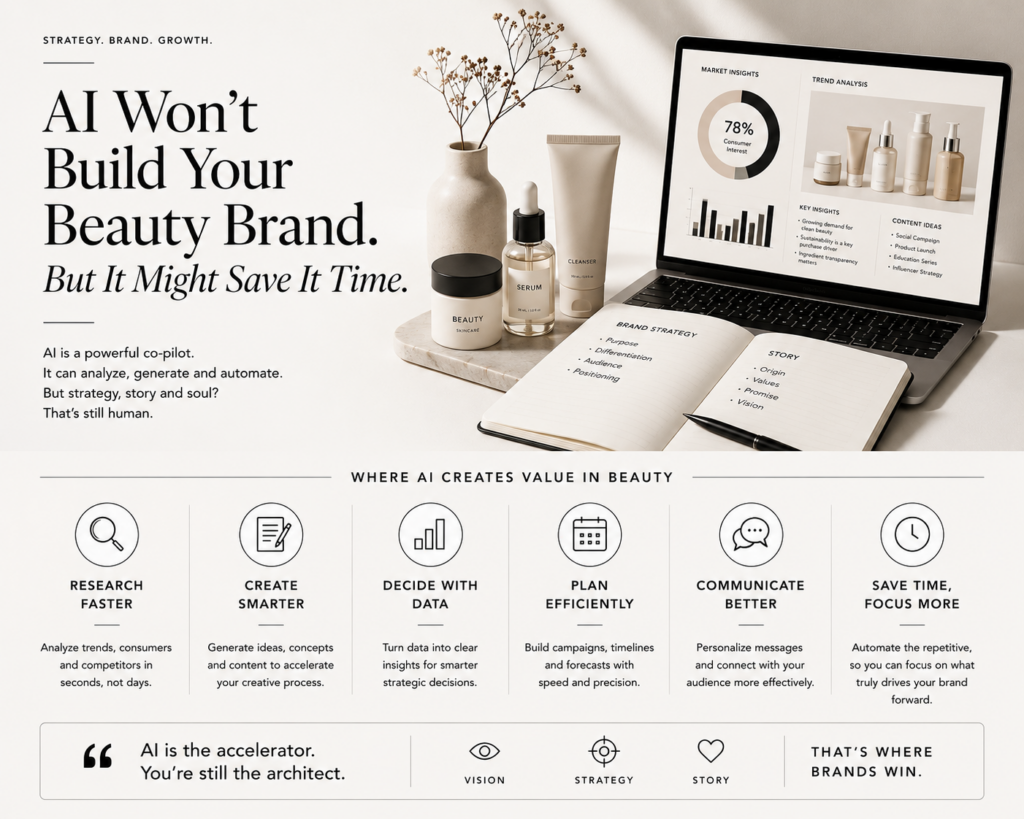
AI Won’t Build Your Beauty Brand. But It Might Save It Time
AI will not build a beauty brand, but it can save a beauty brand a great deal of time: it is excellent at consumer research, content drafts, personalisation, trend spotting and sales forecasting, and useless at retail relationships, brand judgement and uncomfortable advice. It is also changing how shoppers find brands, because more and more of them now ask ChatGPT or Google’s AI answers what to buy. This article sets out what AI does well for beauty brands, what it cannot do, how to make your brand visible in AI answers, and where a founder should start.
Every founder I speak to is asking about AI right now. Some are genuinely curious. Some are anxious. A few have already made expensive mistakes because they confused a tool with a strategy. So let me tell you what I have seen work, what I have seen fail, and how to think about this without either dismissing it or drinking the Kool-Aid.
Key points
- Use AI for five jobs: consumer intelligence, content drafts, personalisation, trend spotting and retail forecasting.
- Keep humans on three: retail relationships, diagnosing whether a brand is ready, and telling founders what they do not want to hear.
- AI is now a shopping channel. In a study of 75,000 brands, web mentions correlated with visibility in Google’s AI Overviews at 0.664, against 0.218 for backlinks.
- Start with intelligence, automate the repetitive, protect the creative, and never let AI write to your retail buyers.
Is AI overhyped for beauty brands?
The hype is real, and so is the noise. Beauty is an industry built on story, sensation and trust. Those things are human, and they always will be. No algorithm understands why a woman reaches for a specific fragrance in the morning, or why a texture feels luxurious rather than just functional. That is lived experience, and it is irreducible.
But AI does not need to understand any of that to be genuinely useful. It needs to do what it is actually good at: processing data at scale, finding patterns faster than any human team, and automating the repetitive so that the creative can breathe. The mistake is expecting it to do more than that. The opportunity is using it ruthlessly for exactly what it does well.
The context makes this urgent. The global beauty market should keep growing about 5% a year to $590 billion by 2030, but discovery and purchase are moving to creators, social platforms and digital marketplaces (McKinsey, June 2026). More channels, more content, more data: exactly the kind of load AI helps with.
What does AI actually do well for beauty brands?
Five jobs, in my experience. Here they are at a glance, then in detail.
| Job | What AI does | What it changes |
|---|---|---|
| Consumer intelligence | Analyses tens of thousands of reviews, comments and searches in hours | You write, formulate and train staff in your customers’ own words |
| Content production | First drafts, variations, translations | A small team can cover every channel without losing its voice |
| Personalisation | Segments, recommendations, churn prediction | Higher repeat purchase, a key metric in beauty DTC |
| Trend intelligence | Tracks searches, social signals and ingredient data at once | An early signal months before a trend peaks |
| Retail performance | Forecasts sell-through, optimises stock by door, flags weak products | You act before the delisting conversation |
Consumer intelligence: faster and deeper
Understanding your customer used to take months of qualitative research, focus groups and expensive studies. AI can now analyse tens of thousands of product reviews, social comments and search queries in hours, and surface the exact language your customer uses to describe what she wants and what frustrates her. Knowing that your customer says “it doesn’t last” rather than “longevity is poor” changes how you write copy, how you brief your lab and how you train retail staff. The insight is the same. The speed is transformative.
Content production: volume without losing your voice
The content demands on a beauty brand in 2026 are brutal: three social platforms, email sequences, product descriptions in several languages, blog articles, retailer copy. A small team cannot produce all of it to a high standard without help. AI does not replace the brand voice; it accelerates it. The brands doing this well use AI for first drafts, variations and translations, then put a person with genuine aesthetic sensitivity on the final edit. The brands doing it badly use AI for the whole thing and wonder why everything feels slightly off. How to define that voice in the first place is covered in beauty brand communication.
Personalisation at scale
Sephora, Charlotte Tilbury and Clinique have used AI-driven personalisation for years: recommending the right product to the right customer at the right moment, based on behaviour rather than demographics. This is no longer a large-brand advantage. Email segmentation based on purchase history, product recommendations on your website and churn prediction that identifies customers about to leave are available now, at accessible prices, and they directly improve repeat purchase rate, one of the most important metrics in beauty DTC.
Trend intelligence: before it peaks
The beauty cycle has accelerated beyond what any human trend team can track manually. AI can monitor search patterns, social listening signals and ingredient databases at the same time, and flag what is building before it saturates TikTok. For a brand in product development, a six-month early signal on an emerging ingredient is worth more than a year of trade shows.
Retail performance: predicting before the buyer calls
AI forecasting tools can predict sell-through before a launch, optimise inventory by door and flag underperforming products before they become a delisting conversation. That matters: most brands that get listed are delisted within 18 months, as we explain in how to get into Sephora, Space NK and Liberty. According to McKinsey, consumer goods companies using AI in demand forecasting reduce inventory costs by up to 20% while improving availability. In beauty retail, where margin is everything, that matters.
What can AI not do for a beauty brand?
This is the part most people skip, and it is the most important one. There are three things AI cannot do, and will not be able to.
Build a relationship with a retail buyer
A Space NK buyer does not take meetings because an algorithm identified them as a high-conversion target. They take meetings because someone they trust made an introduction, or because they have followed a brand over time and believe in it. Retail relationships are built on credibility, consistency and human judgement. AI has no role here. Retailers also expect margins of 45% to 65% in prestige beauty and a clear activation plan; that negotiation is a human one.
Tell you whether your brand is actually ready
AI can tell you your sell-through is at 34%. It cannot tell you whether that is because your price architecture is wrong, your retail partner is not activating the brand properly, or your product simply does not fit the customer in that store. Diagnosis requires context, context requires experience, and experience is human. That is why we built the CURATE Score™: a structured diagnostic across six dimensions, scored by people who have run beauty brands.
Give the advice a founder does not want to hear
The most valuable thing a consultant does is not produce analysis. It is to tell the truth when the truth is uncomfortable: that your brand is not ready for the US market yet, that your pricing undercuts your positioning, that your hero product is not strong enough to anchor a retail launch. AI optimises for what you ask it. It does not push back. It does not carry the weight of having seen fifty brands make the same mistake. That judgement, which only comes from years of doing the work, cannot be automated.
How do beauty brands get recommended by ChatGPT and Google’s AI answers?
This is the part of AI most brands are not yet thinking about: AI is no longer only a tool you use, it is also a place where your customers look for products. When a shopper asks ChatGPT, Perplexity or Google “what is the best mineral sunscreen for sensitive skin”, the answer names a few brands. If yours is not among them, you are invisible at the moment of decision.
What gets a brand named? The best public data comes from an Ahrefs study of 75,000 brands published in May 2025. The factor most correlated with visibility in Google’s AI Overviews was how often the brand was mentioned across the web (0.664), followed by mentions using the brand’s name as link text (0.527) and brand search volume (0.392). Backlinks, the classic SEO signal, scored only 0.218. Brands in the top quarter for mentions averaged 169 AI Overview mentions, more than ten times the next quarter (14), and 26% of brands had none at all. These are correlations, not proof of cause, but they point to four practical steps:
- Earn independent mentions: press coverage, expert commentary, creator content and community discussion. See beauty PR.
- Make your own site easy to quote: clear facts, short direct answers, question-based headings and FAQ sections on product and service pages.
- Keep the facts consistent everywhere: the same claims, ingredients and prices on your site, retailer pages and press materials.
- Check what AI says about you: ask ChatGPT, Perplexity and Google about your category every month, and track whether your brand appears and how it is described.
How does We-Curate use AI?
We use AI in our work: for market intelligence, consumer signal analysis, content production and competitive research. It makes us faster and more precise. We also use it to audit how visible our clients are in AI search, and to find the passages on their websites that AI assistants are least likely to quote.
But what we sell is not AI. What we sell is twenty-five years of pattern recognition, an active network of retail relationships on both sides of the Atlantic, and the willingness to say what needs to be said, even when it is not what a founder was hoping to hear. Our founder launched Christian Louboutin Beauty and led it through its acquisition by Puig; that kind of experience is what no model can supply. More in We Built Beauty Brands. Then We Started Consulting.
The brands that will win in the next five years are not the ones that use the most AI. They are the ones that use it intelligently, moving faster on what can be automated while protecting and investing in what cannot: relationships, creativity, authenticity, craft. That is what luxury beauty runs on.
Where should a beauty founder start with AI?
Here is a simple way to prioritise.
| Use AI for | Keep human |
|---|---|
| Review and social listening analysis | Brand narrative and founder voice |
| First drafts of product descriptions, emails, captions, SEO content | Campaign concepts and final edits |
| Email segmentation and product recommendations | Relationships with retail buyers and investors |
| Demand forecasting and stock by door | Decisions on pricing, positioning and market entry |
| Trend and ingredient signals | Product and brand judgement |
1. Start with intelligence, not execution
Use AI first to understand your market better: consumer sentiment, competitive positioning, trend signals. It is low risk and high return, and it makes every other decision sharper.
2. Automate the repetitive, protect the creative
Email sequences, product description variants, social caption drafts and SEO content are good candidates for AI-assisted production. Campaign concepts, brand narrative and founder voice are not. Keep the human where the brand lives.
3. Never let AI talk to your retail partners
Not in emails. Not in pitch decks that feel generated. Not in follow-ups with no personal texture. Retail is relationship. The moment a buyer feels they are corresponding with a machine, you have lost something that is very hard to recover.
4. Check your visibility in AI answers
Once a quarter, ask the main AI assistants about your category and your brand. If you are absent or described wrongly, the fix is usually more independent coverage and clearer facts on your own site.
Frequently asked questions
How can beauty brands use AI effectively?
Beauty brands can use AI for consumer intelligence, content production at scale, personalised email marketing, retail demand forecasting and trend spotting. The key is to use AI to speed up operational and analytical work while keeping human judgement and creativity at the centre of brand decisions.
Can AI replace a beauty consultant?
No. AI can process data faster and produce content at scale, but it cannot build retail relationships, give uncomfortable strategic advice, or judge whether a brand is ready for a new market. That judgement comes from years of direct experience.
What AI tools should beauty brands use in 2026?
The most useful are consumer sentiment analysis platforms for review and social mining, AI-assisted email personalisation tools such as Klaviyo, demand forecasting software for retail inventory, and AI writing assistants for copy drafts. The right tool depends on your stage and your most pressing problem.
Can a small beauty brand afford AI tools?
Yes. Most AI tools that matter at growth stage, such as email personalisation, content assistance and social listening, are priced for independent brands. The barrier is no longer cost; it is knowing which tools solve a real problem.
How do I get my beauty brand recommended by ChatGPT or Google’s AI answers?
Earn independent mentions through press, experts and creators, make your own site easy to quote with clear facts and FAQs, and keep your facts consistent everywhere. In an Ahrefs study of 75,000 brands, web mentions were the factor most correlated with visibility in Google’s AI Overviews.