
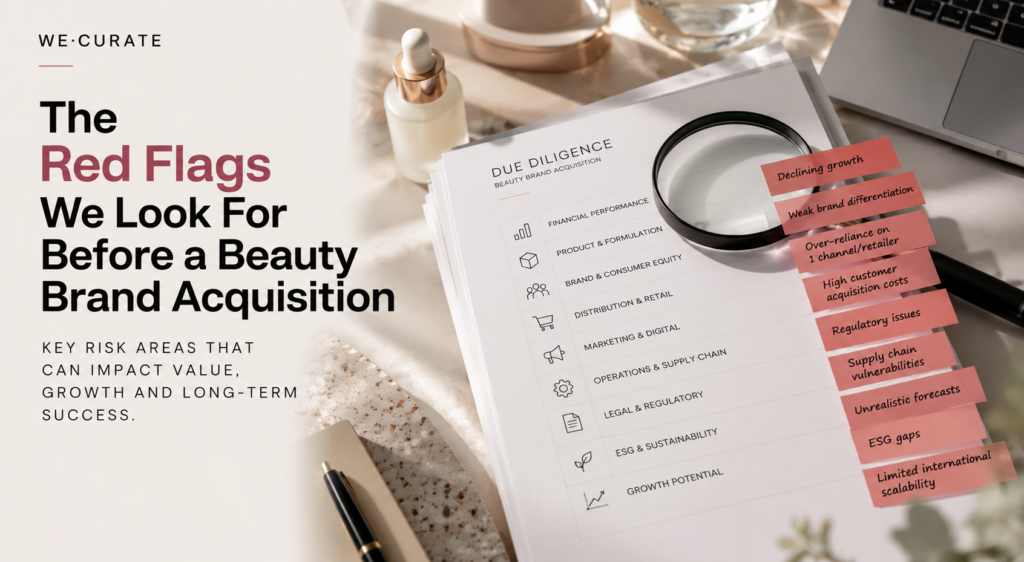
The Red Flags We Look For Before a Beauty Brand Acquisition
By Virginie Duchatelle, Founder & CEO, and Sébastien Clavier, COO at We-Curate.
Most beauty brands that disappoint after an acquisition did not hide anything. The warning signs were in the data. They were simply read as growth.
Beauty is unusual in that its most attractive metrics and its most dangerous ones often look identical for a year or two. Revenue climbing steeply, a product selling out, a major retailer expanding space each can signal a brand building durable equity, or a brand spending it.
These are the ten signals we test first.
1. Sell-in growing faster than sell-through
The single most important check in beauty. Shipments to retailers are recorded as revenue; consumer purchases are what actually happened. When shipments outpace point-of-sale for more than a couple of quarters, inventory is accumulating at retail and a correction is coming through returns, markdowns or a sharp drop in future orders.
This one signal explains a large share of post-deal disappointments in the category.
2. Growth that is entirely distribution
Revenue rising while sales per door fall is a brand approaching the end of a lever rather than building momentum. Decompose growth into new doors, productivity per door, price and mix, and new consumers. If almost all of it is doors, ask how many doors are left.
2b. The reverse: productivity rising with no room to expand
Less common and worth noting. Strong productivity in a brand that has already saturated its channels means the next stage of growth requires a new channel, a new category or a new market — each of which carries execution risk the plan may not have priced.
3. Concentration in one retailer
When a single account carries a dominant share of revenue, that retailer holds the pricing, the promotional calendar and the shelf space. Test what the P&L looks like if that account cuts space by a third, and whether a credible second pillar exists.
4. A hero product with nothing behind it
One product carrying most of the revenue is normal in beauty. One product carrying most of the revenue with no tested pipeline behind it is a risk. Look for a development process and products in validation, not a roadmap of concepts.
5. Promotional dependency
Track the share of volume sold at full price over time. A brand whose growth increasingly depends on discounting is converting brand equity into revenue, and the conversion is difficult to reverse. This matters more now that US mass and prestige are converging and consumers scrutinize value more closely.
6. Repeat purchase flat while new customers rise
Acquisition can mask retention for a long time. If new customer numbers grow while repeat rate and purchase frequency stay flat or decline, the brand is renting demand rather than building a base. Ask for cohort data, not blended averages.
7. Blended acquisition metrics on direct-to-consumer
A blended customer acquisition cost that mixes paid, organic and retail-driven traffic hides the number that matters: what it costs to acquire a genuinely incremental customer through paid media today. Ask for the channel-level view and the trend over eight quarters.
8. Founder dependency in relationships and creative
In beauty, brand vision, retailer relationships and product direction frequently sit with one person. That is not a flaw — it is often the reason the brand works. It becomes a red flag when the investment case assumes those assets survive a transaction without addressing what happens to that person.
9. Regulatory and claims exposure, especially in the expansion plan
Product claims, labeling and compliance obligations differ by market, and the gap is widest where the plan assumes international growth. A US brand whose value case depends on European expansion may need reformulation, relabeling and separate regulatory representation. If nobody has checked, the plan’s timeline is optimistic.
10. Margins supported by something temporary
Favorable one-off supplier terms, a currency position, a promotional holiday from a retailer, or costs absorbed by a founder who is not paying themselves. Test which parts of the gross margin survive normalization.
What is not a red flag
Deal teams new to beauty often raise three things that usually are not problems.
Slowing direct-to-consumer growth at scale. As a brand builds retail distribution, DTC growth naturally moderates. The question is whether DTC is performing its intended role — margin, data, testing, loyalty — not whether it is still the fastest-growing channel.
Falling social engagement. Engagement metrics decline as a brand matures beyond its early-adopter audience. If repeat purchase, full-price sell-through and retail productivity are holding, this is normal.
A narrow product range. Focus is a strength in beauty. A brand with four excellent products and clear positioning is frequently a better asset than one with forty and no point of view.
How these are tested
Each of these signals requires data the management presentation rarely leads with: retailer point-of-sale, weeks of inventory at retail, returns and markdown history, cohort retention, channel-level acquisition costs, and the full-price share of volume over time.
Testing them is the core of commercial due diligence on a beauty brand, and the same framework underpins our strategic audit when a brand is assessing itself rather than being assessed.
Frequently Asked Questions
What are the biggest red flags when acquiring a beauty brand?
The most significant are sell-in growing faster than sell-through, growth driven entirely by new distribution while productivity per door falls, heavy concentration in one retailer, a hero product with no pipeline behind it, and rising dependence on promotions.
Why does sell-in versus sell-through matter so much in beauty?
Because shipments to retailers are recorded as revenue while consumer purchases are what actually happened. A persistent gap means inventory is building at retail, which typically corrects later through returns, markdowns or reduced orders.
Is founder dependency a reason not to acquire a beauty brand?
Not by itself. Founder-led vision and relationships are often why the brand works. It becomes a risk when the investment case assumes those assets continue without addressing the founder’s role after the transaction.
Is slowing DTC growth a warning sign for a beauty brand?
Usually not. As retail distribution grows, direct-to-consumer growth naturally moderates. The relevant question is whether DTC is fulfilling its strategic role rather than whether it remains the fastest-growing channel.
What data is needed to test these signals?
Retailer point-of-sale data, weeks of inventory held at retail, returns and markdown history, cohort retention data, channel-level customer acquisition costs, and the share of volume sold at full price over time.
Testing a Beauty Brand Before a Transaction
If you are assessing a beauty or luxury brand ahead of a deal, or preparing one for sale, these are the questions we are usually brought in to answer.
Request a Confidential Conversation →
Related reading: Commercial Due Diligence for Beauty Brands · The Beauty Brand Strategic Audit · US Beauty Brand Growth Strategy