
Commercial Due Diligence for Beauty Brands: What Investors Should Test Before They Buy
By Virginie Duchatelle, Founder & CEO at We-Curate. More than twenty-five years in premium and luxury beauty, across the US, UK and EMEA.
Commercial due diligence on a beauty brand answers one question: once the money is in, can the growth, the retail position and the brand equity actually carry the investment case?
Financial due diligence checks that the numbers are right. Commercial due diligence asks whether they will hold. In most sectors those two answers sit close together. In beauty they can drift a long way apart, because what creates value here (heat around the brand, goodwill with retailers, the ability to hold a price) usually looks its best just before it turns.
Why beauty is harder to diligence than it looks
Beauty brands can grow very quickly, and the reasons they grow are often not the reasons they last. One product goes viral. A retailer has a great first year with the brand. Distribution gets pushed hard. Each of these produces a revenue curve that looks wonderful in a deck and says very little about year five.
The backdrop matters too. Circana puts US prestige beauty growth at 4% in 2025 and mass at 5%, with the two segments converging. If the market grows at mid-single digits and your target grows three or four times faster, someone is losing share to it. You want to know who, how, and for how long they will let it happen.
The ten questions a beauty CDD must answer
1. Where has growth actually come from?
Start here, because everything else depends on it. Split growth into four sources: new doors, more sales per door, price and mix, and consumers who are genuinely new. Growth that came mostly from opening doors is the first to slow, and it rarely announces itself in a management presentation. Door count goes up, productivity quietly goes down, and the top line looks fine for a while.
2. Is it sell-in or sell-through?
If I could ask for only one dataset, it would be retailer point-of-sale. Shipments to retailers are booked as revenue. Consumer purchases are what actually happened. When the first runs ahead of the second for a few quarters, stock is piling up in someone else’s stockroom, and it comes back later as returns, markdowns or a very thin reorder. Ask for weeks of inventory at retail and return rates alongside it.
3. How concentrated is the business?
Look at it three ways: by retailer, by channel and by product. One retailer carrying most of the revenue, or one hero product carrying most of the margin, is a risk you are buying along with the brand.
4. Is the brand heat durable?
Social demand can be completely real and still not last. The way to tell is to watch what happens as the novelty wears off: repeat purchase, review volume, search interest, the share of units sold at full price. If those hold, you have a brand. If they fade with the posts, you have a moment.
5. Does the brand have pricing power?
How much of the volume needs a promotion to move? Mass and prestige are converging, and shoppers are scrutinizing value harder than they did a few years ago. A price architecture that only works on discount will not survive a hold period.
6. Is there an innovation pipeline behind the hero product?
Most beauty brands start with one hero product. That is normal. What matters is what comes next. If the plan depends on launches that do not exist yet, I want to see a real development process with products in testing, not a mood board.
7. How healthy are the retail relationships?
A listing is not the same as a safe listing. Read the terms, look at how the brand’s space has moved over the last few seasons, check the promotional commitments, and find out how category buyers talk about the brand when nobody from the brand is in the room.
8. What regulatory and claims exposure exists?
Claims, labeling and compliance, market by market. This gets skipped more often than it should, especially when the investment case leans on international growth. A claim that passes in the US can be a problem in Europe.
9. Is the expansion case credible?
If the plan assumes national scale across the US, or a move into the UK and Europe, the assumptions on channels, timing, cost and regulation need to be checked by someone who has actually done it. Spreadsheets are generous about timelines.
10. How dependent is the brand on its founder?
In many beauty brands, the vision, the retailer relationships and the creative direction all sit with one person. That is often exactly why the brand works. It is also why the investment case has to say plainly what happens to that person after closing.
What a category specialist adds to a generalist CDD
Generalist CDD teams are good at what they do: market sizing, consumer research, benchmarking. You need that work.
What they usually cannot tell you is how a prestige retail buyer will look at this brand next season, whether the price sits right for its retail tier, or whether the brand is building equity or spending it. That comes from having worked inside the category.
So in practice we work as the beauty workstream next to a generalist provider or the fund’s own deal team. Alongside them, not instead of them.
Buy-side and vendor due diligence
Buy-side diligence is commissioned by the buyer, to test the case before signing.
Vendor diligence is commissioned by the seller, usually a founder or an exiting fund, to find the weak spots before a buyer does and to put a growth case in front of the market that has already been tested. For a beauty brand going into a sale, it often decides whether the buyer discounts the uncertainty or pays for the plan.
How we approach it
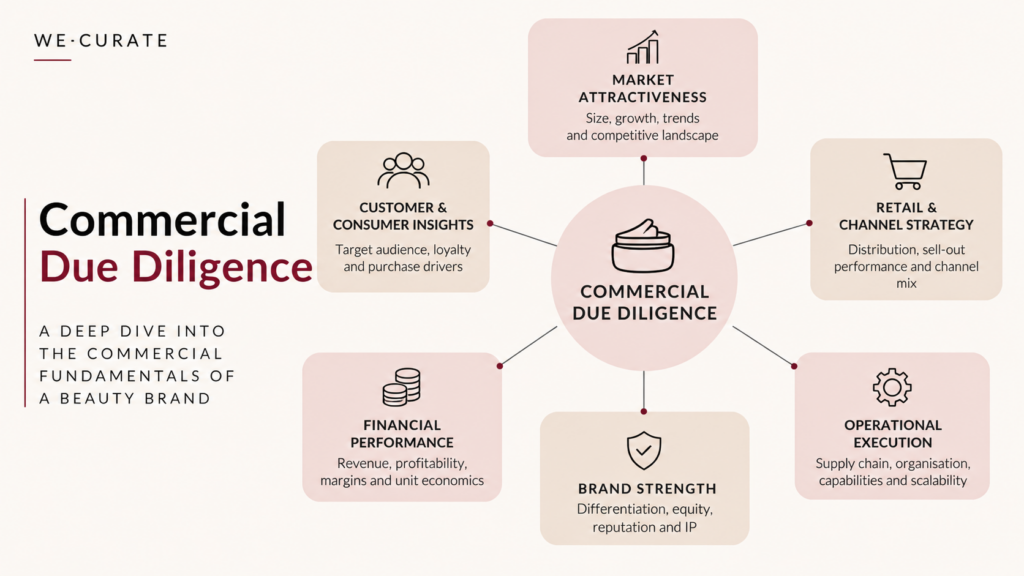
We use the same framework as our strategic audit: where growth came from, how the retail and channel mix really works, how healthy the brand equity is, whether pricing holds, and whether the US growth case and any move into Europe stand up. It runs to the deal timetable, and the findings are written for an investment committee, not for a marketing team.
How we work with funds, growth investors and acquirers before, during and after a deal is set out on our beauty brand due diligence and investment advisory page.
Frequently Asked Questions
What is commercial due diligence for a beauty brand?
It is an independent assessment of a beauty brand’s growth drivers, market position, retail relationships, brand equity and expansion plan, carried out for an investor or acquirer before a transaction to test whether the investment case holds.
How is commercial due diligence different from financial due diligence?
Financial due diligence checks that historical figures are accurate. Commercial due diligence asks whether the drivers behind those figures will continue and whether the growth plan is credible.
What is the difference between sell-in and sell-through?
Sell-in is what a brand ships to retailers. Sell-through is what consumers actually buy from those retailers. A persistent gap usually means inventory is building up at retail, and it tends to reverse later through returns, markdowns or smaller orders.
What is vendor due diligence?
Vendor due diligence is commissioned by the seller before a sale process, to find weaknesses early and to present potential buyers with a growth case that has already been tested.
Can a beauty specialist work alongside a generalist due diligence provider?
Yes, and it is often the best setup. The specialist covers the category: retail, pricing and brand equity. The generalist provider or the deal team covers market sizing and customer research.
How much does commercial due diligence on a beauty brand cost?
It depends on the mandate: the size of the business, how deep the analysis needs to go and how tight the deal timetable is. Scope and timing are agreed first, then the price.
Discuss a Due Diligence Mandate
If you are looking at a beauty or luxury brand ahead of a deal, or getting one ready for sale, start by telling us the question you need answered.
Request a Confidential Conversation →
Source: Circana 2025 US beauty results, via BeautyMatter
Related reading: The Beauty Brand Strategic Audit · Brand Value Creation in PE-Owned Beauty Portfolios · Beauty Brand Due Diligence for Investors