
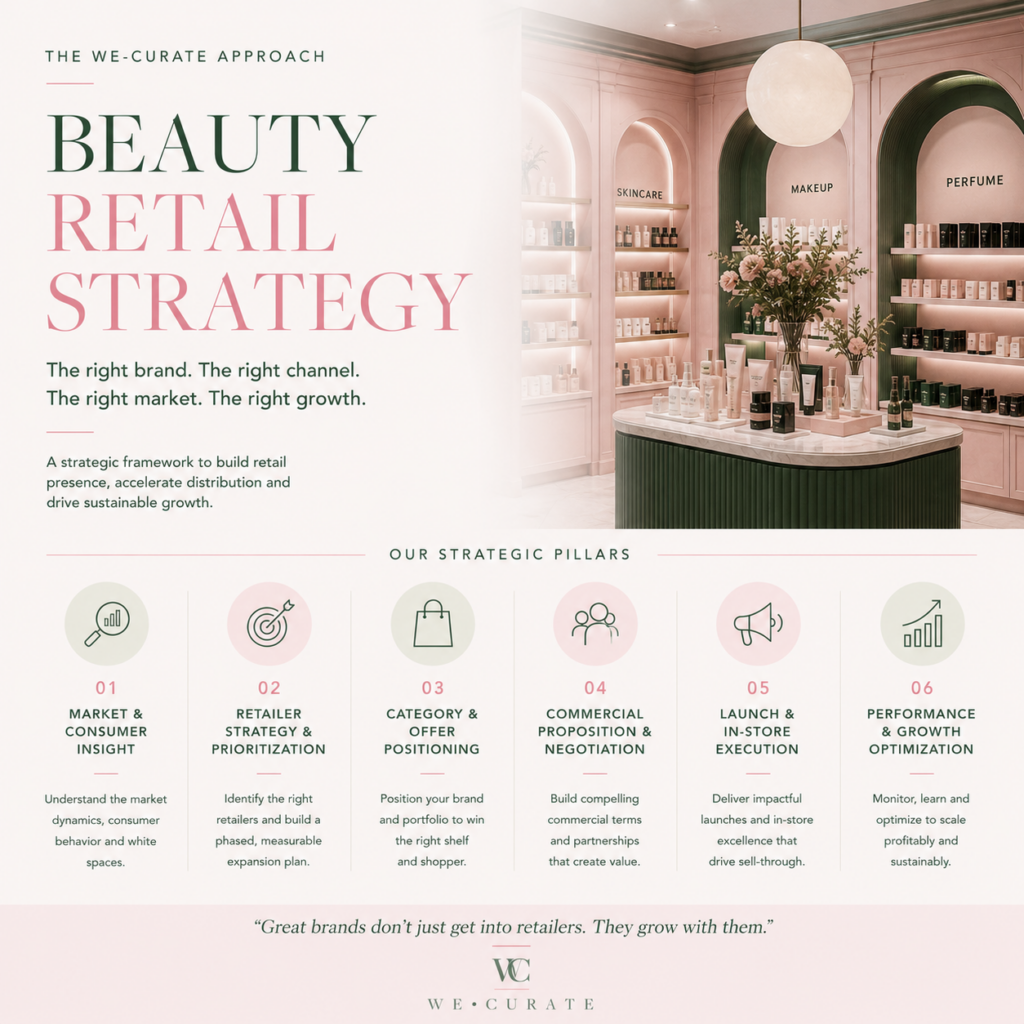
Beauty Retail Strategy: How to Get Into Sephora, Space NK and Liberty
Every beauty brand wants to be in Sephora. Or Space NK. Or Liberty. The prestige, the footfall, the credibility it is understandable. But most brands approach retail with no real beauty retail strategy. They send a cold email, ship samples, and wait. Then they wonder why nothing happens.
I have been on both sides of this. At NEST NEW YORK, I built UK and European retail distribution from scratch Space NK, Selfridges, Harvey Nichols, Harrods. At Courrèges Parfums, I navigated the US market, including conversations with Sephora and Neiman Marcus. What I know for certain: getting into a major retailer is not about luck. It is about preparation, positioning, and timing.
Here is what actually works.
What Retailers Are Really Buying
Before you pitch, you need to understand what a buyer is actually evaluating. They are not buying your product. They are buying a business decision.
A buyer at Sephora or Space NK has limited shelf space, a buying budget, and performance targets. Every new brand they bring on is a bet. If you underperform, they lose money and sometimes they lose their job. That is the context you are walking into. Your job is to make them feel confident in that bet.
What They Want to See
Proof of demand. DTC numbers, sell-through data, a real community. Not just beautiful packaging and a compelling brand story. Data.
A clear customer. Who buys your product? What age, what lifestyle, what beauty routine? If you cannot answer in one sentence, the buyer will pass.
Realistic sell-through projections. Not inflated forecasts. Buyers have seen every version of the optimistic spreadsheet. Show you understand what a new brand typically sells at their retailer and build from there.
A marketing commitment. Sephora especially wants to know what you will spend to drive customers into their stores. Influencer activations, paid social, sampling campaigns. Retail is not a passive distribution channel. It never was.
Category fit. Are you filling a gap, or competing with five other brands already on their shelves? Buyers are always looking for white space. Know where you sit in their assortment and articulate it.
Sephora, Space NK, Liberty: Three Very Different Doors
A smart beauty retail strategy is not one-size-fits-all. The US and UK retail landscapes are fundamentally different, and what opens a door in London will not automatically open one in New York.
Sephora (US)
Sephora operates on scale. They want brands that can perform across hundreds of doors. They look for social proof — strong TikTok presence, influencer traction, a community that buys. They move fast when they see momentum, and they move just as fast when performance disappoints.
The main routes in are the Sephora Accelerate programme for early-stage brands, the brand submissions portal, or an introduction through a distributor or industry contact. The portal does work but expect a 6 to 12 month process at minimum.
Space NK (UK)
Space NK is more curation-focused. They have around 75 doors in the UK, but their customer is loyal, knowledgeable, and high-spending. They look for genuine differentiation: ingredients, efficacy, heritage, or a strong brand aesthetic.
A winning beauty retail strategy for Space NK starts with building relationships before you pitch. Their buying team attends industry events, reads the beauty press obsessively, and pays attention to what editors recommend. Organic PR, not paid placements carries real weight with them.
Liberty London
Liberty is a completely different beast. They are not buying a brand. They are curating an edit. They want stories, heritage, provocation. Your brand has to mean something aesthetically, culturally.
If you are launching a clean fragrance brand with a strong narrative, Liberty should absolutely be on your list. If you are launching another retinol serum, it is the wrong door entirely.
How to Approach a Buyer
Most brands approach retail too early. They have a great product and no data. The buyer says no, not because the product is bad, but because there is nothing to bet on yet.
Build the Case Before You Pitch
Six months before you approach a retailer, start building the data that will matter in that meeting. Run a DTC business, even a small one. Track your conversion rate, average order value, and repeat purchase rate. Get into one independent boutique and track sell-through. Collect press coverage. Build your social proof.
When you finally sit in that meeting, you are not pitching a product. You are presenting a business case.
Know Your Numbers
Walk in with monthly DTC revenue and growth rate, sell-through at any existing retail partner, cost of customer acquisition, average order value, and estimated margin for the retailer, typically 45 to 65 percent depending on category.
A buyer who sees a founder that knows their numbers will take that founder seriously. Most founders who walk in talking only about their brand story are politely shown the door.
Be Specific About the Ask
Not “we would love to be in your stores.” Instead: “We would like to start with a 10-door pilot, focused on your London locations, with a 6-month review.” Specificity signals that you understand retail. It also makes the buyer’s job easier — a small, defined ask is far easier to approve than a vague ambition.
After You Get In: The Work Begins
Here is the part nobody talks about. Getting into a major retailer is not the win. Staying in is the win.
Most brands that get listed are delisted within 18 months. Underperformance is the number one reason. And underperformance usually comes from one of two places: the brand assumed the retailer would do the marketing, or the brand ran out of cash to support the channel.
Retailer Support Costs Money
Budget for gondola end placements and in-store fixtures, retailer-exclusive gift-with-purchase, staff training and in-store events, and co-funded digital campaigns. These are not optional extras. They are the cost of performing well in a competitive retail environment.
Track Sell-Through Weekly
You should know your sell-through numbers before the buyer does. If a product is underperforming, respond immediately: a sampling campaign, an influencer push, a promotional mechanic. Waiting for the buyer to flag underperformance is already too late.
Treat the Buyer as a Partner
The buyer who listed you is your most important retail relationship. Stay in contact. Share what is working. Flag problems early. The brands that get reordered, expanded, and protected during difficult periods are the ones that behave like partners — not vendors who only surface when they need something.
The Most Common Mistakes
I have watched genuinely excellent brands lose their retail placement, or never get it because of avoidable errors.
Approaching too early. No data, no proof of demand. The buyer says “come back in a year” and most brands never do.
Pitching the wrong retailer. I once saw a very niche botanical skincare brand pitch Boots. Boots passed. Space NK said yes immediately. Know where your customer actually shops before you book the meeting.
Underestimating the margin. Retail margins for prestige beauty sit between 45 and 65 percent. Add freight, returns, and marketing support, and the economics can turn negative fast. Model it before you commit.
No post-launch marketing budget. Getting listed does not drive footfall. You need to send people to the store. Brands that get listed and spend nothing on activation almost always underperform.
Not knowing the competition. Walking into a pitch without knowing who is already on the shelf and exactly why you are different is a basic error. Buyers will ask. Be ready.
A Beauty Retail Strategy Built on Reality, Not Hope
Retail is not a shortcut to scale. It is a distribution channel that rewards preparation and punishes wishful thinking. The brands that win in Sephora, Space NK, and Liberty do not get lucky. They show up ready: with data, with a clear customer, with a marketing plan, and with the financial model to back it all up.
If you are thinking about retail and want an honest assessment of where your brand actually stands, that is exactly what we do at We-Curate. Before you book that buyer meeting, let’s make sure you are ready for it.
Frequently Asked Questions
A beauty retail strategy is the plan a brand uses to select the right retail partners, approach buyers effectively, and sustain performance once listed covering everything from pitch preparation to post-launch sell-through management.
You can submit through Sephora’s brand portal, apply to their Accelerate programme if you are early-stage, or secure an introduction through a distributor or industry contact. Build proof of demand first: DTC data, social traction, and press coverage before you approach.
Buyers look for proof of customer demand, clear brand positioning, category differentiation, realistic sell-through projections, and a brand-funded marketing commitment. They are evaluating a business case, not just a product.
It depends on your brand. Space NK suits curation-focused brands with strong editorial credentials and a UK customer. Sephora suits brands with social traction that can scale across many doors. The right retailer is the one where your customer already shops.
Typically 6 to 18 months from first contact to launch, depending on the retailer, buying cycle, and your brand’s readiness. Very few brands move faster than 6 months. Most take longer than they expect.