
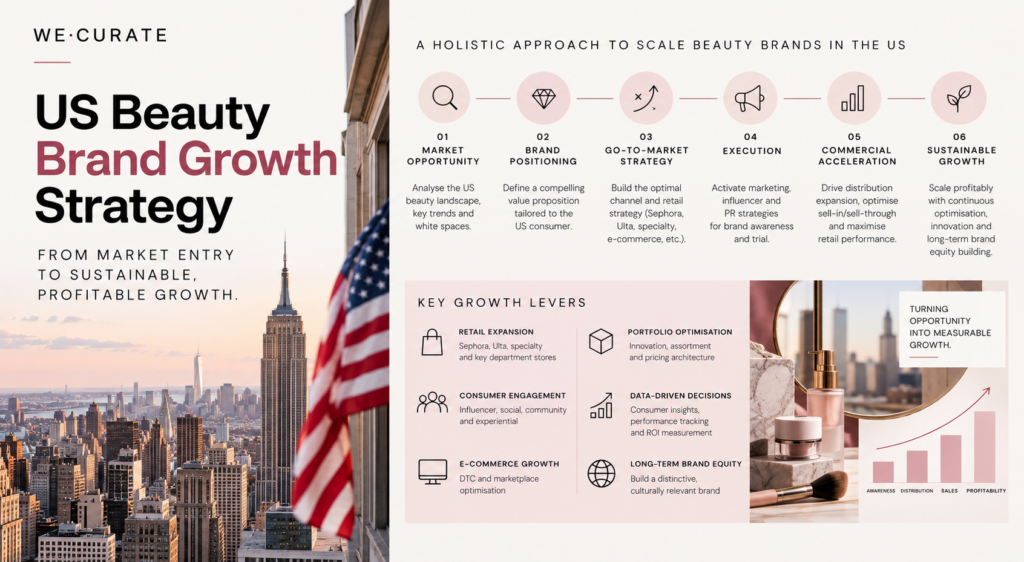
US Beauty Brand Growth Strategy: The Decisions Behind the Next Stage of Scale
By Virginie DUCHATELLE, CEO at We-Curate. US-based, working with beauty and luxury brands on domestic growth and international expansion.
A US beauty brand growth strategy is the set of decisions that determines where a brand’s next stage of revenue comes from which channels, which retailers, which price points, which regions and which consumers and in what order.
Most brands that stall at scale do not stall for lack of demand. They stall because growth was the sum of opportunities rather than the result of decisions. Every channel that said yes was accepted. Every retailer that wanted an exclusive got one. Every new launch was layered on top of the last. At a certain size, that accumulation stops compounding and starts competing with itself.
This is the point where a board, a new CEO or an investor asks the question that matters: where does the next stage of growth actually come from, and what does it cost?
The market context
US beauty is growing, but slowly, and the gap between channels has narrowed. According to Circana, US prestige beauty sales grew 4% to $36 billion in 2025, while mass beauty grew 5% to $72.7 billion. Circana also found that only 14% of US beauty buyers believe a higher price signals higher quality, and describes the mass and prestige markets as converging.
In a market growing at mid-single digits, above-market growth is no longer available from the category. It has to be taken — from competitors, from better channel choices, from under-served regions and from sharper price architecture. That makes the strategic decisions more consequential, not less.
Decision 1 : Know where your growth has actually come from
Before deciding where growth should come from, decompose where it came from. Revenue growth in beauty comes from four sources, and they have very different futures:
- More points of distribution — new doors, new retailers, new channels
- Higher productivity per point — more sales per door, per listing, per shelf metre
- Price and mix — higher average selling price, premium launches, fewer promotions
- New consumers — genuine penetration gains, not the same consumer buying in more places
A brand whose growth came mainly from distribution is often approaching the limit of that lever without knowing it. Productivity per door is falling quietly while the top line still rises. This is the single most common finding in the growth diagnostics we run, and it changes the plan entirely.
Decision 2 : Design the channel architecture, do not inherit it
Prestige department stores, beauty specialty, mass, drug, Amazon, your own direct-to-consumer site and professional channels each carry a different margin structure, a different consumer and a different signal about what the brand is.
With mass and prestige converging, the old rule — prestige brands stay out of mass — is no longer absolute. But the decision to cross that line is close to irreversible. A brand that enters mass to find growth rarely returns to prestige pricing power.
The question is not which channels are growing. It is which channel architecture your brand’s positioning, pricing and margin structure can sustain for the next five years.
Decision 3 : Manage retailer concentration as a risk, not a success
Many US beauty brands reach scale on the back of one or two retail partners. That is a strength until it is not. When a single retailer represents a dominant share of revenue, that retailer effectively controls your promotional calendar, your assortment, your space and your negotiating position.
A board should know, at any time, what share of revenue sits with the largest account, what happens to the P&L if that account reduces space by a third, and what the credible second pillar is. Investors will ask. It is better to have asked first.
Decision 4 : Fix productivity before adding doors
Adding doors to a brand with weak productivity multiplies the weakness. Inventory spreads thinner, marketing support per door falls, sell-through drops, and retailers begin to reconsider the space.
The disciplined sequence is the reverse: raise productivity in existing doors until the retailer asks for expansion, then expand. Door count is an output of a healthy brand, not a strategy for creating one.
Decision 5 : Treat US geography as a growth lever
The US is not one market. Many brands over-index heavily in a few metropolitan areas and under-index across large parts of the country, while their plans treat national distribution as if penetration were even.
Regional analysis often reveals growth that requires no new retailer at all — only better allocation, regional marketing and store-level focus inside accounts the brand already has. It is frequently the cheapest growth available.
Decision 6 : Decide what direct-to-consumer is for
At scale, DTC is rarely the growth engine it was at launch. Customer acquisition costs rise, and retail partners watch price parity closely.
The strategic question is what DTC is for: margin, consumer data, launch testing, loyalty, or brand storytelling. Each answer implies a different investment level. A DTC operation run to maximise revenue at the expense of retail relationships is a common and expensive mistake.
What investors test in a US growth case
When a private equity fund, a growth investor or a corporate acquirer assesses a US beauty brand, the growth plan is the centre of the diligence. The questions are predictable:
- How much of historical growth came from distribution, and how much is left?
- How dependent is the business on its largest retail account?
- Is door productivity rising or being diluted?
- Can the price architecture hold as mass and prestige converge?
- Where is the regional white space, and what does capturing it cost?
- What does the plan look like if the most optimistic assumption fails?
A brand that can answer these before an investor asks negotiates from a stronger position. A brand that cannot will have them answered by someone else, on someone else’s terms.
Five mistakes that stall US beauty brands at scale
1. Growing by accumulation
Saying yes to every channel and retailer until the brand’s positioning is set by its distribution rather than by its strategy.
2. Confusing door count with health
Reporting distribution gains while productivity per door declines.
3. Crossing into mass without a plan to stay premium
A one-way door that is often walked through for a single year of growth.
4. Letting one retailer write the plan
Concentration that feels like partnership until the terms change.
5. Treating the US as one market
Planning national distribution on the assumption of even penetration that does not exist.
Frequently Asked Questions
What is a US beauty brand growth strategy?
It is the set of decisions that determines where a beauty brand’s next stage of US revenue comes from — channel architecture, retailer mix, door productivity, pricing, regional penetration and the role of direct-to-consumer — and the order in which to pursue them.
How fast is the US beauty market growing?
According to Circana, US prestige beauty grew 4% to $36 billion in 2025 and mass beauty grew 5% to $72.7 billion. In a mid-single-digit market, above-market growth must come from share gains and better strategic choices rather than from the category.
Should a prestige beauty brand enter mass retail to grow?
Only as a deliberate strategic decision. Mass and prestige are converging, but entering mass is close to irreversible for pricing power. The decision should follow an assessment of positioning, margin structure and long-term brand value, not a single year’s growth target.
How should a beauty brand manage dependence on one retailer?
By tracking the share of revenue held by its largest account, modelling the P&L impact of a reduction in space, and building a credible second channel or retail pillar before the dependence becomes a negotiating weakness.
What do investors look at in a beauty brand’s US growth plan?
Investors typically test the sources of historical growth, retailer concentration, door productivity trends, the resilience of price architecture, regional white space, and the downside case if key assumptions fail.
US Growth Strategy at We-Curate
US domestic expansion is where We-Curate does its strongest work: diagnosing where growth has really come from, designing channel and retail architecture, and building a plan a board or an investor can act on — with a P&L attached, through our Strategic Audit.
Request a Scoping Conversation →
Sources: Circana 2025 US beauty results, via BeautyMatter · Circana, US beauty first half 2025
Related reading: The Beauty Brand Strategic Audit · How to Expand a US Beauty Brand to Europe · Fractional COO for Beauty Brands