
Entering the EU Beauty, Lifestyle and Luxury Market: What the Plan Actually Costs
Entering the EU Beauty, Lifestyle and Luxury Market: What the Plan Actually Costs
By Virginie Clavier, Founder & CEO at We-Curate. More than twenty-five years in premium beauty, lifestyle and luxury, across the US, UK and EMEA.
European expansion appears in almost every growth plan we review. It is rarely costed correctly.
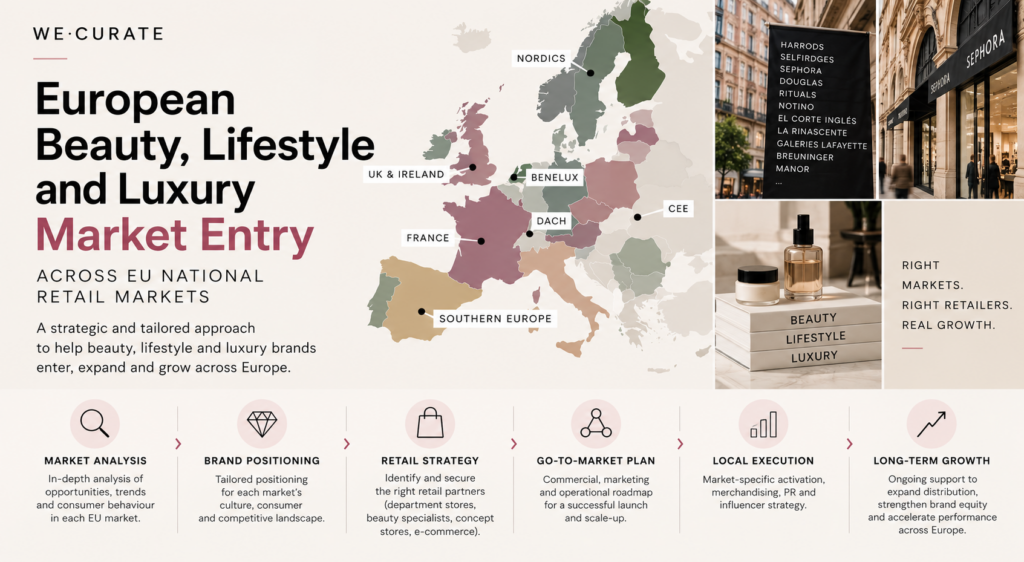
The reason is structural. The European Union is presented in board decks as a single market of 450 million consumers, because that is how the trade agreements describe it. Commercially it is nothing of the kind. It is twenty-seven countries with separate retail structures, separate buying teams, separate languages, separate VAT rates and separate consumer behavior — sitting on top of one regulatory framework that is stricter than the American one.
For a board approving a European plan, or an investor pricing one inside a valuation, the question is not whether Europe is attractive. It is whether the plan in front of them reflects how Europe actually works.
The market, in the numbers that matter
According to Cosmetics Europe, European retail sales of cosmetics and personal care products reached €110 billion in 2025. Skin care is the largest category at €32.3 billion, followed by toiletries at €26.4 billion, hair care at €20.3 billion, fragrances at €17.1 billion and color cosmetics at €13.6 billion.
The concentration is the first thing a board should see. Six countries carry most of the value: Germany at €18.0 billion, the United Kingdom at €14.7 billion, France at €14.5 billion, Italy at €12.8 billion, Spain at €11.8 billion and Poland at €6.4 billion.
The second thing is less intuitive. The fastest-growing markets in 2025 were not the large Western European ones. Cosmetics Europe reports the strongest performers as Bulgaria at +10.1%, Romania at +9.2%, Portugal at +8.2%, Hungary at +8.1% and Poland at +7.6%.
That matters for how a plan is read. A European strategy built entirely on France and Germany is targeting the largest pools of value and some of the slowest growth, in the most contested shelf space in the region. That can be the right decision. It should be a decision, not an assumption.
Where European plans most often miss
1. Treating the EU as one commercial market
Retail is national. Germany, Austria and Switzerland run largely through Douglas. France, Italy, Spain and Poland are Sephora and Marionnaud territory. The Nordics, the Netherlands and Central Europe each have their own structures. Buying teams are national, terms are national, and a listing in one country does not create a listing in the next.
A plan that assumes a single European rollout, with one set of terms and one marketing budget, is describing a market that does not exist.
2. Under-costing the regulatory layer
Every cosmetic product placed on the EU market needs a Responsible Person established in the Union, notification through the CPNP portal before sale, and a Product Information File containing a Cosmetic Product Safety Report. The Responsible Person’s name and address must appear on the packaging.
Three consequences are routinely missing from plans: the cost and liability of appointing a third-party Responsible Person where there is no EU entity, a label redesign for every product, and the possibility of reformulation, because the EU restricts a substantially longer list of substances than the United States does and applies the precautionary principle.
Reformulation moves a European launch from a distribution project to a product development project. Those are different timelines and different costs, and the difference is usually discovered after the plan has been approved.
3. Forgetting that lifestyle and luxury goods follow different rules
This is the point most often missed in multi-category brands, and it is why the three categories cannot share one compliance plan.
Cosmetics sit under the sector-specific Cosmetics Regulation, with its own Responsible Person regime. Non-cosmetic consumer goods — accessories, tools, devices, candles, textiles, hard goods — fall under the EU’s General Product Safety Regulation, which since December 2024 requires a responsible economic operator established in the EU before a product can be sold, including through online channels.
A beauty brand with an accessories line, or a lifestyle brand spanning both, needs both regimes addressed. A plan that treats the whole portfolio as “cosmetics compliance” has a gap in it.
4. Assuming US or UK marketing transfers
EU cosmetic claims are governed by common criteria requiring that claims be truthful, supported by evidence, honest and fair. Claims implying a physiological or medical effect can move a product into a different regulatory category altogether. Environmental and “clean” language is under increasing scrutiny across Europe.
Every claim then has to work in every language the brand sells in — which is a legal exercise and a translation exercise at the same time. Rewriting a claims architecture for Europe is a project with a budget line, not an edit.
5. Building the plan on simultaneous multi-country entry
The most common pattern we see in plans that underdeliver: four or five countries entered in the same year, each supported thinly, none reaching the productivity that would justify the next stage of investment.
Sequential entry — win one country, use that proof to open the next — is slower on paper and faster in practice. A plan showing simultaneous entry across Western Europe should be tested hard on where the marketing and commercial capacity is actually coming from.
6. Pricing country by country without an architecture
European retail prices include VAT, and VAT rates differ by country. Cross-border e-commerce is routine, so divergent pricing between national markets becomes visible to consumers and to retailers, who will raise it.
A European price architecture has to be designed deliberately, accounting for VAT variation, retailer margin by market and local logistics — then defended.
[À REMPLACER PAR VIRGINIE — encadré expert]
2-3 phrases vécues, première personne : un plan européen dont le coût ou le délai réel s’est révélé très différent de ce qui était prévu (réglementaire, retail, séquencement). Anonymisé : catégorie, marché, écart constaté.
The questions a board or an investor should ask
- Which single country does this plan win first, and why that one? An answer naming a region rather than a country is a warning.
- Has the full ingredient list been checked against EU restrictions? If not, the timeline is provisional.
- Who is the Responsible Person, and is that cost in the model? Including, separately, the responsible economic operator for any non-cosmetic products.
- What does the label redesign cost across the range, in every required language?
- Which national retailers are in the plan, and what has actually been discussed with them? Ambition and conversation are different things.
- What is the price architecture across markets, after VAT?
- Who is on the ground in Europe? Buyers, press and partners deal with people they can reach in their time zone.
- What does the plan look like if the first country takes twice as long? In our experience it frequently does.
These are the questions we test when European expansion forms part of an investment case, within commercial due diligence on a beauty brand, and the same questions a brand should answer for itself in a strategic audit before capital is committed.
Where the UK fits
Since Brexit, Great Britain is a separate regulatory territory with its own Responsible Person requirement and its own notification portal. Northern Ireland continues to follow EU rules under the Windsor Framework.
Commercially, the UK remains the most common first European market for American brands — shared language, mature prestige e-commerce, and a single territory rather than twenty-seven. A European plan that includes the UK should show it as a separate workstream, with its own compliance path and its own budget. Our detailed view is in how to enter the UK beauty market.
A note on what this article is not
This is a view of how to evaluate a European plan. The operational detail of executing one — market selection, compliance sequencing, retail approach and logistics — is covered in how to expand a US beauty brand to Europe.
Frequently Asked Questions
How big is the European beauty market?
European retail sales of cosmetics and personal care products reached €110 billion in 2025, according to Cosmetics Europe. The largest national markets are Germany at €18.0 billion, the UK at €14.7 billion, France at €14.5 billion, Italy at €12.8 billion, Spain at €11.8 billion and Poland at €6.4 billion.
Which European beauty markets are growing fastest?
Cosmetics Europe reports the strongest performing markets in 2025 as Bulgaria (+10.1%), Romania (+9.2%), Portugal (+8.2%), Hungary (+8.1%) and Poland (+7.6%) — all outside the largest Western European markets.
What is required to sell cosmetics in the EU?
A Responsible Person established in the European Union, notification of every product through the CPNP portal before sale, a Product Information File containing a Cosmetic Product Safety Report, and compliant labeling showing the Responsible Person’s name and address.
Do lifestyle and luxury goods follow the same EU rules as cosmetics?
No. Cosmetics fall under the sector-specific Cosmetics Regulation. Non-cosmetic consumer goods such as accessories, tools and hard goods fall under the General Product Safety Regulation, which since December 2024 requires a responsible economic operator established in the EU. A multi-category brand needs both addressed.
How long does EU market entry take for a beauty brand?
Allow several months for regulatory work in a single territory, and considerably longer where reformulation or label redesign across a range is required. From decision to meaningful retail presence in one European market, a realistic plan is measured in quarters rather than months.
Should a brand enter several European countries at once?
Rarely. Retail structures, buying teams and terms are national, and simultaneous entry usually means each market is supported too thinly to reach the productivity that justifies further investment. Sequential entry, using proof from one country to open the next, is slower on paper and generally faster in practice.
Testing a European Plan
If European expansion is part of an investment case you are assessing, or a growth plan your board is being asked to approve, the useful work is testing the assumptions before the capital follows them.
Request a Scoping Conversation →
Sources: Cosmetics Europe, Economic value of the cosmetics and personal care industry · CTPA, The UK and the European Market
Related reading: The Beauty Brand Strategic Audit · Commercial Due Diligence for Beauty Brands · How to Expand a US Beauty Brand to Europe · How to Enter the UK Beauty Market · Red Flags Before a Beauty Brand Acquisition