
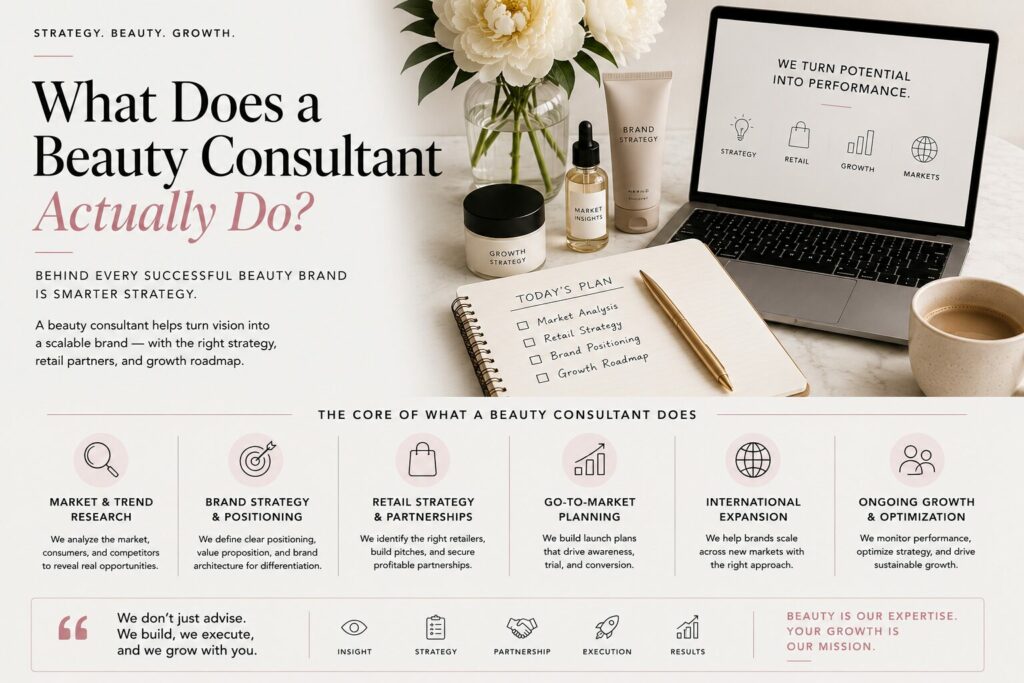
What Is a Beauty Consultant, and What Do They Actually Do?
A beauty consultant is an independent expert who helps beauty, skincare and fragrance brands grow: setting strategy and pricing, opening retail distribution, entering new markets such as the US or UK, and sometimes stepping in as a part-time executive. Not to be confused with an in-store beauty advisor, who recommends products to shoppers.
By Virginie, Founder & CEO at We-Curate. Based in London and Paris.
A beauty brand agent represents your brand to retail buyers. They do not buy your stock. They do not take ownership of your inventory. They sell on your behalf, usually on commission, and you keep control of pricing, terms and the customer relationship.
That last sentence is the whole distinction, and it is the one brands most often get wrong — usually in the contract, occasionally in court.
The confusion is partly linguistic. American brands say “agent” and often mean distributor. European brands say “consultant” and sometimes mean agent. The words are used loosely, the commercial and legal consequences are not.
Agent, distributor, consultant: the differences that matter
| Agent | Distributor | Consultant | |
|---|---|---|---|
| Takes ownership of stock | No | Yes | No |
| Sets the retail price | You do | They do | N/A |
| Owns the retailer relationship | Shared | They do | No |
| How they are paid | Commission on sales | Margin on resale | Fee or retainer |
| Carries commercial risk | Limited | Yes | No |
| You keep market control | Yes | Largely no | Yes |
A distributor buys your product and resells it. They carry the inventory risk, they take a margin, and in practice they own that market. You gain reach quickly and you lose visibility and control. Recovering a market from a distributor relationship that has gone stale is one of the harder things a brand can attempt.
An agent sells on your behalf without taking title. You invoice the retailer directly. You see the data. You keep the relationship. You pay commission on what sells. Slower to scale, far easier to steer.
A consultant advises. They may build your retail strategy and prepare your pitch, but they are not commercially representing you in front of a buyer.
These roles overlap in practice, and many brands need more than one. What causes damage is signing an agreement that says one thing while both parties assume another.
What a beauty brand agent does day to day
- Buyer access and relationship management. The central function. A good agent already has standing relationships with the buyers who matter in your category, and enough credibility that their recommendation is taken seriously.
- Pitch preparation and presentation. Building the commercial story — assortment, margin, marketing support, sell-through projection — and presenting it in the format that retailer expects.
- Negotiating terms. Margin, promotional participation, payment terms, listing fees where they apply, and the marketing commitments attached.
- Range planning and assortment. Which SKUs, at what price, in what order, for which door count.
- Trade marketing coordination. Working with the retailer on visual merchandising, sampling, staff education and promotional calendar participation.
- Sell-through monitoring. Watching the numbers after the listing and acting before a buyer does. This is the part brands under-value most, and it is what decides whether year two happens.
- Market intelligence. What competitors are doing, what buyers are asking for, where the category is moving.
The listing is the visible part. The retention work after it is where the value actually sits.
How beauty agents are paid
Commission on net sales is the standard structure. Rates vary considerably by market, category and the level of service involved, and there is no single industry figure worth quoting.
Three structures you will encounter:
- Pure commission. The agent takes the risk. Rates are correspondingly higher, and the agent will be selective about which brands they take on.
- Retainer plus commission. A lower commission rate against a monthly fee. Common where the agent is doing significant strategic and trade marketing work alongside selling.
- Retainer with success fees. Used where the sales cycle is long — as it is for prestige retail listings, where twelve to eighteen months from first conversation to shelf is normal.
Be direct about one thing when you negotiate: what happens to commission on accounts the agent opened, after the relationship ends. This is where agency agreements become expensive, and in the UK it is not entirely a matter of what you agree.
The legal layer nobody mentions
If your agent operates in Great Britain and negotiates the sale of goods on your behalf, the Commercial Agents (Council Directive) Regulations 1993 almost certainly apply — and they contain obligations you cannot contract out of.
The main ones:
- Minimum notice periods on termination, scaling with the length of the relationship: one month in the first year, two months in the second, three months in the third and thereafter. These cannot be shortened by agreement.
- Compensation or indemnity on termination. An agent is generally entitled to a payment when the relationship ends — including where you terminate for legitimate commercial reasons rather than misconduct. Unless the contract explicitly provides for indemnity, compensation is the default, and compensation is not capped.
- Commission rights that survive termination, including on transactions concluded shortly after the relationship ends.
- The agent has one year from termination to claim, after which the right is lost.
Two points that catch brands out. First, these Regulations apply to goods, not services — which is why a consultant arrangement sits outside them and an agent arrangement does not. Second, they apply where the agent’s activities are carried out in Great Britain even if your agreement is governed by another law. A US-law agency contract does not remove a UK agent’s statutory rights.
The UK government reviewed these Regulations and confirmed in February 2025 that they would remain in force without amendment. This is not a rule that is about to disappear.
None of the above is legal advice. If you are appointing an agent in the UK or EU, take proper legal advice on the agreement before you sign it, not after you want to end it.
When you need an agent
- You are entering a market where you have no buyer relationships and no local presence
- You want to keep control of pricing, positioning and data rather than hand the market to a distributor
- Your category is relationship-led — prestige and niche beauty both are
- You are not yet at the volume that justifies a full-time in-market commercial hire
- You need someone who can be physically present with buyers and retail teams
When you do not
- Your brand is not retail-ready. An agent cannot sell a brand that lacks demand signals, compliance or supply capability. They will decline, or they will fail, and both cost you time.
- You want strategy, not representation. If the gap is knowing what to do rather than who to call, you need a consultant or fractional leadership.
- You want to hand over the whole market. That is a distributor conversation, with different economics and different risk.
- You cannot support the listing. Retail requires marketing investment, sampling, training and stock. An agent who wins you a listing you cannot service has done you harm.
How to choose one
- Ask which buyers they have sold to, by name and by year. Beauty is small. This is verifiable, and vagueness here is disqualifying.
- Ask what else is in their portfolio. A conflicting brand in your category is an obvious problem. A portfolio of forty brands is a different one — you will not get attention.
- Ask what they will not represent. An agent with standards has a reputation with buyers. An agent who takes everything does not.
- Understand who owns the relationship if it ends. Contractually and practically. Then read the previous section again.
- Check the market, not just the category. A strong UK agent is not automatically useful in the US, where the retail structure and vocabulary are different.
Frequently Asked Questions
What is a beauty brand agent?
A beauty brand agent represents a brand to retail buyers without taking ownership of stock. They sell on the brand’s behalf, usually on commission, while the brand retains control of pricing, terms and the retailer relationship.
What is the difference between a beauty agent and a distributor?
An agent sells on your behalf and does not take title to your goods; you invoice the retailer and keep control of the market. A distributor buys your product and resells it, taking a margin and generally controlling pricing and the retailer relationship in that market.
How much commission does a beauty brand agent take?
Commission is calculated on net sales and varies significantly by market, category and scope of service. Structures range from pure commission to retainer-plus-commission, with the latter common where the agent is also delivering strategic and trade marketing work.
Do UK commercial agents have legal protections?
Yes. The Commercial Agents (Council Directive) Regulations 1993 give agents operating in Great Britain statutory rights including minimum termination notice periods, commission rights after termination, and compensation or an indemnity when the relationship ends. These rights apply even where the agreement is governed by another country’s law, and the UK government confirmed in February 2025 that the Regulations remain in force without amendment.
Should a beauty brand use an agent or a distributor?
Use an agent when you want to retain control of pricing, data and the retailer relationship, and you can support the market yourself. Use a distributor when you want speed and reach and are prepared to give up control of that market.
Can one agent cover both the UK and the US?
Rarely well. The retail structures, buyer relationships and commercial conventions differ substantially between the two markets. Most brands are better served by market-specific representation.
How We-Curate Works with Brands on Retail Representation
We-Curate connects beauty and lifestyle brands with retail partners across the UK, US and EMEA. We work as a commercial partner rather than a volume agency — a small portfolio, direct buyer relationships, and involvement that continues after the listing is signed.
We also tell brands when representation is not what they need yet. That conversation is usually more valuable than the alternative.
Discuss Retail Representation →
Related reading: How to Get Your Beauty Brand into Sephora · Beauty Retail Strategy: Sephora, Space NK and Liberty · How to Enter the UK Beauty Market · What Is a Fractional CMO for Beauty Brands? How Much a beauty consultant costs ? Beauty retail strategy Strategic Audit