
What Is a Fractional CMO for Beauty Brands?
What Is a Fractional CMO for Beauty Brands?
By Jerome, U.S. General Manager & Global CMO at We-Curate. Based in Los Angeles, working with luxury, lifestyle and beauty brands across the US and EMEA.
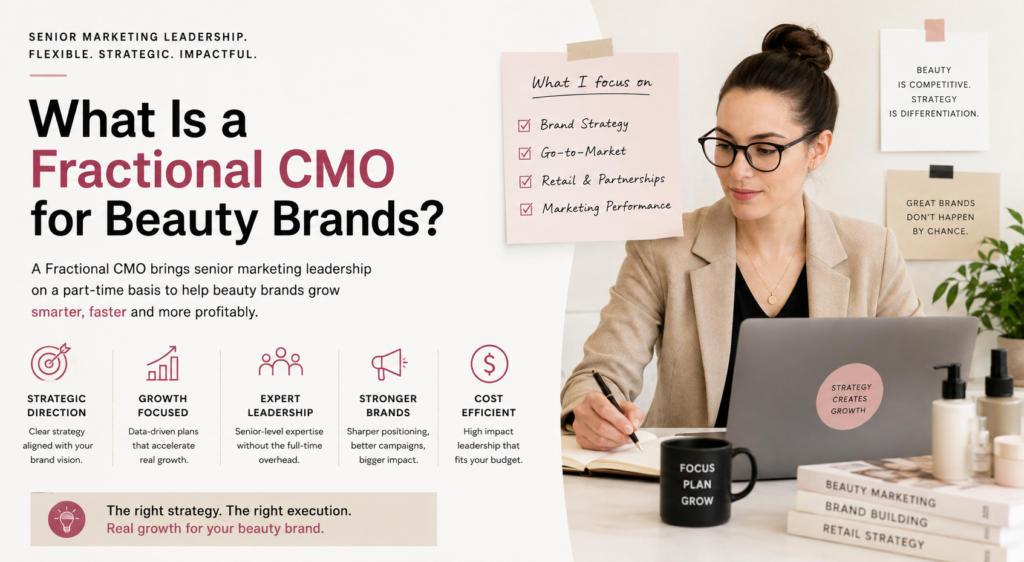
A fractional CMO is a senior marketing executive who leads your marketing function on a part-time, ongoing basis, typically two to three days a week, on a monthly retainer, with real accountability for results.
Not a consultant who delivers a strategy deck and leaves. Not an agency that executes campaigns without owning the outcome. A fractional CMO sits inside your business, makes decisions, and is answerable for what happens next.
The model has moved from unusual to standard. Across industries, roughly half of growth-stage companies now use some form of fractional marketing leadership. In beauty, adoption has been slower — and that is exactly why it is worth understanding properly.
Why the beauty industry is different
Most of what is written about fractional CMOs is written for B2B software companies. The advice does not transfer cleanly to beauty, for three reasons.
Retail relationships are the job
In SaaS, a CMO owns demand generation. In beauty, a CMO who cannot get a meeting with a Sephora, Space NK or Boots buyer is missing the central lever of the business. Retail is not a channel you market into. It is a relationship you manage.
This is the single biggest reason generic fractional CMOs fail in beauty. The strategic thinking is sound. The access is not there.
The calendar is fixed and unforgiving
Beauty runs on retail calendars set months ahead. Gifting windows, seasonal launches, retailer promotional cycles, awards deadlines and press lead times of three to five months. A marketing leader who arrives without knowing this rhythm loses a quarter learning it.
Regulation shapes marketing, not just operations
What you can claim, how you can claim it, and which markets you can claim it in are regulatory questions with direct marketing consequences. A beauty CMO needs working fluency in FDA and MoCRA requirements in the US, and UK and EU cosmetics regulation in Europe. This is not a legal department problem that arrives after the campaign is built.
What a fractional CMO actually owns
A properly scoped fractional CMO engagement in beauty covers:
- Brand positioning and architecture — who the brand is for, what it stands against, and how that translates by market
- Retail strategy and buyer preparation — channel selection, pitch development, and the commercial narrative that gets a listing
- Pricing architecture — RRP by market, margin structure, promotional participation
- Go-to-market planning — launch sequencing, market prioritisation, phasing
- PR, press and creator strategy — including the long lead times that catch most brands out
- Team and agency oversight — hiring, briefing, and holding external partners to account
- Performance accountability — sell-through, not impressions
What it does not cover: daily campaign execution, content production, or acting as a full-time employee in a part-time seat. A fractional CMO directs. They do not do everything themselves.
What it costs
Fractional CMO retainers generally run between $5,000 and $25,000 per month, depending on scope, seniority and time commitment. Most standard engagements two to three days a week with a full remit sit in the $10,000 to $15,000 band.
A full-time CMO in the US costs $250,000 to $400,000 in total compensation, before benefits, equity, recruiting fees and ramp time. Loaded properly, the true first-year cost is considerably higher.
The saving is real, and it is typically 40 to 70 percent. But cost is the least interesting part of the argument.
The more useful difference is speed and risk. A fractional engagement starts in weeks rather than the three to six months an executive search takes, and it can be scaled down without severance exposure. For a brand entering a new market, that optionality is worth more than the money saved.
When a fractional CMO is the right call
- You are entering a new market and need senior leadership there before you can justify a permanent hire
- Your founder is still acting as CMO and it has become the constraint on growth
- You have marketing execution — agencies, freelancers, a junior team — but nobody setting direction
- You are preparing for a retail pitch, a funding round, or an exit, and need the commercial story to hold up
- You are between CMOs and cannot afford six months of drift
When it is the wrong call
I am more interested in this list, because the failures are predictable.
- You need execution, not direction. If nobody is available to act on the strategy, a fractional CMO becomes an expensive advisor. Hire an agency or a doer instead.
- You want a full-time CMO at part-time cost. Two days a week is two days a week. Brands that scope full-time expectations into a fractional retainer get frustrated by month three, and they are right to be — the scoping was wrong.
- Your marketing team is already large. Daily leadership of fifteen people is not a fractional role.
- You are past roughly $25–30M in revenue and marketing is the primary growth engine. At that point the economics tip toward a permanent hire.
Fractional CMO vs consultant vs agency
These three are routinely confused, and the confusion is expensive.
A consultant diagnoses and recommends. The engagement ends with a deliverable. Accountability ends there too.
An agency executes within a defined brief. It owns campaign performance, not business outcomes, and it does not sit in your leadership meetings.
A fractional CMO owns the function. They set the strategy, brief the agency, manage the team, and answer for the result. The distinction is accountability, not hours.
Many brands need two of the three at once. A fractional CMO directing a focused agency is a common and effective structure.
How to evaluate one for a beauty brand
- Ask which retailers they have personally sold into. Names, categories, and when. Beauty is small enough that this is verifiable.
- Ask what they would want to change in your first ninety days. A serious answer will be specific and slightly uncomfortable.
- Ask how they measure themselves. If the answer is engagement metrics rather than sell-through, revenue or listings, keep looking.
- Ask what they will not do. Anyone who claims the whole remit at two days a week is either overselling or has not scoped it.
- Check the market fit, not just the category fit. A CMO with deep US experience is not automatically useful in the UK, and the reverse is more common than people admit.
Frequently Asked Questions
What is a fractional CMO?
A fractional CMO is a senior marketing executive who leads a company’s marketing function part-time, usually two to three days a week on a monthly retainer, with accountability for strategy, team direction and commercial outcomes.
How much does a fractional CMO cost?
Fractional CMO retainers typically range from $5,000 to $25,000 per month, with most full-remit engagements between $10,000 and $15,000. This represents roughly 40 to 70 percent less than the total cost of a full-time CMO.
How is a fractional CMO different from a consultant?
A consultant delivers a recommendation and the engagement ends. A fractional CMO owns the marketing function on an ongoing basis, directs the team and agencies, and is accountable for results.
How long does a fractional CMO engagement last?
Most engagements run six to eighteen months. Shorter than three months rarely allows enough time to show results; longer than two years usually signals the role should become permanent.
Does a fractional CMO need beauty industry experience?
For a beauty brand, yes. Retail buyer relationships, category knowledge, the retail calendar and cosmetics regulation are not transferable from other sectors. A generalist fractional CMO will spend the engagement learning what a beauty specialist already knows.
Can a fractional CMO help with retail listings?
A beauty-specialist fractional CMO should be able to prepare the brand for retail, build the commercial pitch, and in many cases open the conversation directly. Access to buyers is one of the main reasons to choose a specialist over a generalist.
Fractional Beauty Leadership at We-Curate
We-Curate provides fractional CMO, COO and commercial leadership to luxury and lifestyle beauty brands across the UK, US and EMEA. Our team has sat on both sides of the retail table, in the markets where our clients want to grow.
We take a small number of fractional mandates at any time, because the model only works when the person is genuinely present in the business.
Discuss a Fractional Mandate →
Related reading: How to Enter the UK Beauty Market · How to Launch a Beauty Brand in the US · Fractional CMO Services · Beauty Retail Strategy