
Brand Value Creation in PE-Owned Beauty Portfolios
Brand Value Creation in PE-Owned Beauty Portfolios
By Sébastien Clavier, COO at We-Curate. Operations, systems and execution across the UK, US and EMEA.
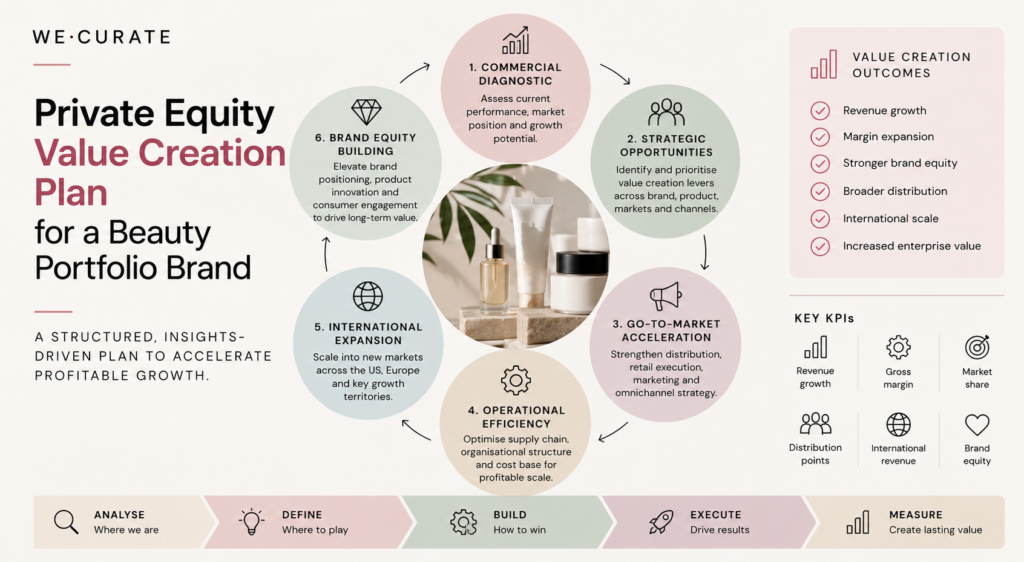
A value creation plan in a beauty portfolio brand is the set of initiatives, owners and numbers that turn the investment thesis into the business the sponsor underwrote. Usually within a defined hold period, and usually faster than the brand has ever had to move.
The diligence answered whether the thesis was credible. What follows answers whether it can be delivered. These are different problems, and in beauty the second one has a specific shape.
The structural tension in beauty
Private equity ownership runs on a defined horizon. Brand equity does not.
A beauty brand’s most valuable asset is how consumers and retailers regard it, and that asset is built slowly and spent quickly. Almost every lever that produces revenue fast — wider distribution, deeper promotions, more launches — draws down on it. Almost every lever that builds it pays back after the hold period has begun to close.
This is why some beauty investments deliver strong numbers for three years and arrive at exit with a weaker brand than they started with. The P&L improved. The asset did not.
A value creation plan that does not name this tension explicitly will resolve it by default, in favor of whatever is measured quarterly.
Where value actually comes from in a beauty brand
Five sources, in the order they are usually available.
1. Retail productivity before retail expansion
Raising sales per door in existing accounts is almost always cheaper, faster and lower-risk than opening new ones — and it is what persuades a retailer to offer more space on its own initiative. Adding doors to a brand with weak productivity multiplies the weakness: inventory thins, support per door falls, sell-through drops, and the retailer reconsiders.
Door count is an output of a healthy brand, not a method for creating one. This is covered in more depth in our view of US beauty brand growth strategy.
2. Price and mix
Reducing promotional dependency, improving the share of volume sold at full price, and shifting mix toward higher-margin products. Slower to show than a distribution push, and far more durable.
3. Operational margin
Supply chain, manufacturing terms, inventory planning, retail vendor compliance and chargeback reconciliation. In beauty this is routinely under-managed and routinely worth real margin points. It is also the one area where improvement costs the brand nothing.
4. Portfolio and assortment discipline
Most brands at this stage carry SKUs that consume working capital, complicate manufacturing and contribute little. Rationalizing the range frees cash and sharpens the proposition at the same time.
5. Geographic and channel expansion
The largest prize and the longest lead time. Entering the EU or the UK carries regulatory work measured in quarters before a single unit ships, and the cost is consistently underestimated in plans written before anyone has done it.
The first hundred days
The first hundred days decide whether the plan is real or ceremonial.
- Re-diagnose rather than assume. The diligence was conducted from outside, under time pressure and with partial data. Inside the business, the picture is always more specific — and sometimes materially different.
- Decompose historical growth properly. How much came from new doors, from productivity, from price and mix, from genuinely new consumers. This determines which levers remain available.
- Name an owner and a number for every initiative. An initiative without both is an intention.
- Fix the reporting before fixing the business. If the brand cannot produce weekly retail sell-through, inventory at retail and full-price share, the board is steering on lagging data.
- Decide what will not be done. Value creation plans fail more often from dilution than from poor choices.
By Sébastien Clavier, COO at We-Curate.
“When I work on a restructuring, I first test whether the strategy and price positioning can translate into profitable execution. I then scrutinise PR, communications and marketing spend against clear objectives and evidence of impact, alongside the full cost of serving each retailer and market. In those first hundred days, my priority is to stop spending that cannot be justified and give every retained initiative an owner, a margin target and a delivery deadline.”
The four mistakes that cost the most at exit
1. Cutting marketing to hit the first year
Marketing is the most visible discretionary line and the easiest to reduce. In beauty it is also the mechanism that sustains retail productivity. The cut shows up in the P&L immediately and in sell-through two to three quarters later, by which point the cause is harder to attribute.
2. Buying revenue with distribution
Opening doors or entering a lower retail tier produces revenue quickly and can permanently reset where the brand sits. Entering mass is close to a one-way decision for pricing power. It is sometimes right. It should never be a way to hit a quarterly number.
3. Launching to fill a plan
Innovation targets are easy to set and easy to meet badly. A sequence of under-supported launches fragments the range, confuses the retail buyer and consumes the marketing budget that existing products needed.
4. Underwriting international expansion no one has priced
European entry in particular is commonly modeled as a distribution exercise. It frequently requires reformulation, relabeling, country-by-country retail negotiation and regulatory representation — quarters of work before the first order.
Building toward the next buyer
The questions a future buyer will ask are known in advance, because they are the questions this sponsor asked at entry. Our view of the red flags we look for before a beauty brand acquisition is, read in the other direction, a specification for the asset to be built.
Four of them are worth managing deliberately throughout the hold:
- Sell-through tracking sell-in. A business whose shipments have outrun consumer purchases will be discounted, however good the revenue line looks.
- Reduced concentration. A credible second retail pillar is worth building even when the first one is performing.
- Demonstrable retention. Cohort-level repeat purchase, not blended averages.
- A pipeline in validation. Products in development, not concepts in a deck.
Addressing these a year before a process begins is the work of vendor due diligence. Addressing them from the first hundred days is simply how the plan should have been written.
Who executes the plan
The common gap is not strategy. It is capacity.
A sponsor-installed CEO typically inherits a team built for the brand’s previous stage, with vacancies in the roles the plan depends on. Permanent executive hiring at this level takes months of search and months of ramp-up — often most of the first year of a hold period.
That gap is where a fractional leadership team is useful: senior capacity across several functions, accountable for the plan, with a handover to permanent executives built in from the start.
Frequently Asked Questions
What is a value creation plan for a beauty brand?
It is the set of initiatives, owners and financial targets that turn an investment thesis into results during a sponsor’s hold period — covering retail productivity, pricing and mix, operational margin, assortment discipline and geographic expansion.
Why is value creation different in beauty than in other consumer categories?
Because the brand itself is a primary asset, and the fastest revenue levers — wider distribution, deeper promotion, more launches — tend to draw down on it. Plans must balance measurable near-term gains against the brand equity a future buyer will assess.
What should happen in the first hundred days after acquiring a beauty brand?
Re-diagnose the business from the inside, decompose where growth has actually come from, assign an owner and a number to every initiative, fix reporting so the board sees retail sell-through and inventory, and decide explicitly what will not be pursued.
Why is cutting marketing spend risky in a beauty portfolio brand?
Marketing sustains retail productivity. Reductions improve the P&L immediately but typically affect sell-through two to three quarters later, when the cause is harder to attribute and the retail relationship is already under pressure.
How should a sponsor prepare a beauty brand for exit?
By managing throughout the hold the things a buyer will test: sell-through consistent with sell-in, reduced retailer concentration, demonstrable cohort retention, and a product pipeline in validation rather than in concept.
Working with Sponsors and Portfolio Brands
We-Curate works with private equity sponsors and their portfolio companies on the brand side of value creation — diagnosing where value actually sits, building the plan with a P&L attached through a strategic audit, and providing the leadership to execute it where the team is not yet in place.
Request a Confidential Conversation →
Related reading: Commercial Due Diligence for Beauty Brands · The Beauty Brand Strategic Audit · The Fractional Leadership Team · Vendor Due Diligence