
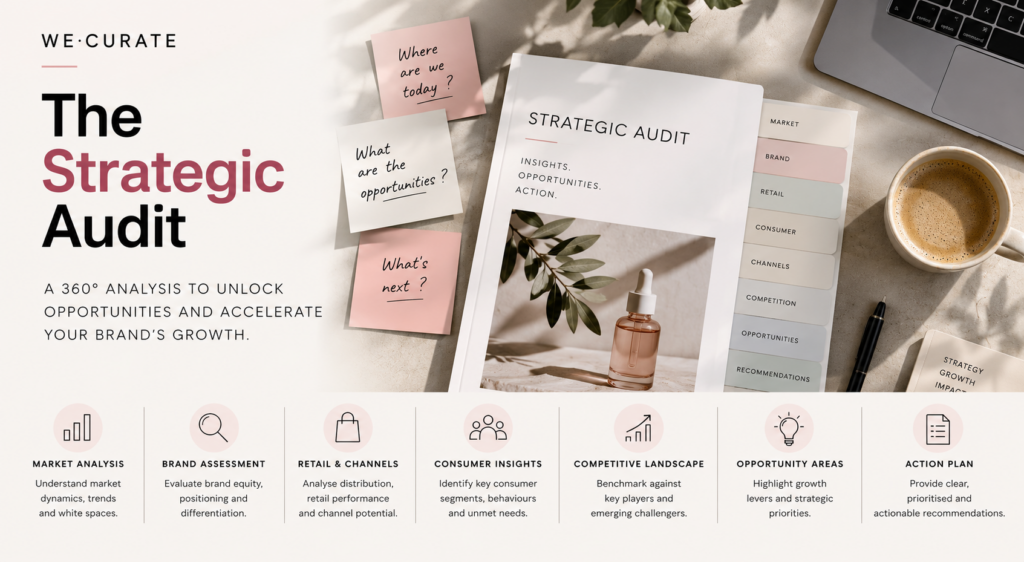
The Beauty Brand Strategic Audit: What It Is, What It Costs, What It Delivers
The Beauty Brand Strategic Audit: What It Is, What It Costs, and What It Delivers
By Virginie Clavier, Founder & CEO at We-Curate. More than twenty-five years in premium and luxury beauty, across the US, UK and EMEA.
A beauty brand strategic audit is an independent, board-level diagnostic of where a brand stands commercially, competitively and operationally — paired with a recommended plan and a full P&L model attached to it.
Most brands commission one once something has already gone wrong. A lender is asking questions. A board member has lost confidence. A private equity sponsor wants a plan before the next check is written. By then the diagnostic is read under pressure, by people with little patience for a document that reads like a marketing deck.
An audit built for a board or an investment committee has to hold up under scrutiny from people who decide with other people’s capital. That is a different standard, and it changes what goes in the document.
Why the diagnostic matters more in this market
US beauty is still growing, but modestly. According to Circana, US prestige beauty sales grew 4% to $36 billion in 2025, while mass beauty grew 5% to $72.7 billion — and the two segments are converging, with only 14% of US beauty buyers believing a higher price signals better quality.
In a market expanding at mid-single digits, above-market growth is no longer available from the category. It has to be taken — through sharper channel choices, better retail productivity and a defensible price architecture. That makes the quality of the strategic decisions far more consequential than it was five years ago, and it is why boards increasingly want those decisions tested by someone outside the business.
What a strategic audit is not
| Strategic audit | Brand audit | Commercial due diligence | Turnaround advisory | |
|---|---|---|---|---|
| Commissioned by | Board, CEO, CRO, sponsor | Marketing leadership | Investor or acquirer | Lenders, board |
| Core question | Where does value come from next? | How is the brand perceived? | Does the investment case hold? | Can the business be stabilized? |
| Scope | Whole commercial position | Identity and perception | Whole position, for a transaction | Balance sheet and cost structure |
| P&L attached | Yes | No | Yes | Yes |
| Ends with | A plan the board can approve | A positioning recommendation | A view for the investment committee | A restructuring plan |
The distinction that matters most is the budget. A strategy without a P&L attached is an opinion, and a board reading forty pages with no numbers will ask, correctly, what it is actually being asked to approve.
What the audit delivers
- Market position and competitive standing — where the brand genuinely sits in its category, not where its positioning statement says it sits
- Brand equity assessment — where it is holding, where it is eroding, and what that erosion is costing
- Growth source analysis — how much past growth came from new distribution, productivity per door, price and mix, or genuinely new consumers, and how much of each is left. This is covered in depth in our view of US beauty brand growth strategy
- Retail and distribution review — which partnerships create value, which quietly destroy margin, and which are worth defending in a downturn
- Pricing and assortment diagnosis — whether the price architecture still matches how the category is shopped
- A recommended path forward — prioritized, sequenced and explicit about trade-offs
- A full P&L model attached to that path, so the board approves numbers rather than intentions
Who commissions one
A strategic audit is commissioned in four situations, and each reader uses the document differently.
A brand in financial or operational difficulty
Here the audit must move fast. A Chief Restructuring Officer or interim executive needs something defensible to lenders within weeks, not quarters. The balance sheet is being addressed by others. The question is whether the brand underneath it is still worth backing, and in what form.
A brand that has just changed ownership
A private equity sponsor has installed new leadership and wants an independent view of where value creation actually sits before committing further capital. The audit speaks the fund’s language: value creation, sequencing, return on each initiative.
A brand under new leadership, with no distress at all
A new CEO, or a founder resetting direction, wants a rigorous outside read before committing to a multi-year plan — precisely because the stakes are too high to rely on internal consensus.
A brand facing a major growth decision
National expansion across the US, a move into a new retail tier, or entry into Europe and the UK. The audit tests the decision before capital is committed to it.
The document changes shape for each reader. The standard does not: every version has to survive a board member who has seen a hundred decks and is looking for the one weak assumption.
Why category expertise changes the answer
Generalist strategy and restructuring firms can diagnose a cost structure and a balance sheet in any industry. That is their strength, and in a restructuring it is indispensable.
What they typically cannot do is judge whether a fragrance launch is priced correctly for its retail tier, whether a brand’s positioning still matches how its category is shopped, or which retail relationships a beauty business must protect at almost any cost.
That is category judgment, and it is the difference between a plan that is directionally sound and one a beauty or luxury board trusts enough to act on.
Alongside a CRO, not in competition
We are not a turnaround firm, and we do not restructure balance sheets. When a Chief Restructuring Officer or a restructuring adviser is already in place, the strategic audit becomes the brand workstream within that mandate: the CRO stabilizes the business, and we determine what the brand should become once it is stable.
That division of labor matters to boards. It keeps financial restructuring with the specialists and puts category decisions with people who know the category.
The same framework, used for a transaction
When the reader is an investor rather than a board, the same diagnostic becomes commercial due diligence on a beauty brand — testing whether the growth, the retail position and the brand equity support the investment case before capital is committed.
Used by a seller ahead of a process, it becomes vendor due diligence: finding what buyers will find, early enough to act on it. And the signals we test first are set out in the red flags we look for before a beauty brand acquisition.
The analysis is consistent. What changes is who is asking, and what decision depends on the answer.
What it costs, and why there is no price list
A strategic audit is scoped and priced to the mandate, not sold from a rate card. The size of the business, the urgency of the situation and the depth of P&L modeling required all change the engagement.
A rapid assessment supporting a lender conversation is a different piece of work from a diagnostic commissioned by a new CEO with a full quarter ahead of them. A single fixed price would fit neither well, so we scope first and price second.
What happens after the audit
Roughly four out of five of our strategic audits lead directly into a longer engagement, typically lasting two to three years.
That is by design. The audit is not written to be read once and filed. It becomes the reference a board, a lender or a sponsor returns to when it is time to hold leadership accountable for the numbers — and the plan it recommends usually needs the people who built it to carry it through. Where a brand does not yet have the leadership to execute, that work is delivered by a fractional leadership team until permanent executives are in place.
Frequently Asked Questions
What is a beauty brand strategic audit?
A strategic audit is a board-level diagnostic of a beauty, luxury or consumer brand’s market position, brand equity, growth sources, retail strategy and pricing, paired with a recommended plan and a full P&L model supporting it.
How is a strategic audit different from a brand audit?
A brand audit assesses perception and identity, and is usually commissioned by marketing leadership. A strategic audit assesses the whole commercial position of the business and attaches a budgeted P&L to the recommended path, so a board can approve a financial plan rather than a direction.
How is a strategic audit different from commercial due diligence?
The analysis is largely the same. A strategic audit is commissioned by the business itself to decide what to do next. Commercial due diligence is commissioned by an investor or acquirer to test whether an investment case holds before a transaction.
Who commissions a strategic audit?
Typically a Chief Restructuring Officer or interim executive during financial difficulty, a CEO installed by a private equity sponsor after an acquisition, a new CEO or founder setting direction, or the leadership of a healthy brand facing a major growth decision.
How long does a strategic audit take?
It depends on the mandate. A rapid assessment supporting a lender conversation runs on a far shorter timetable than a full diagnostic commissioned by new leadership with a quarter available. Scope and timetable are agreed before pricing.
Can a strategic audit run alongside a restructuring firm?
Yes. In a restructuring, the strategic audit acts as the brand workstream: the restructuring adviser addresses the balance sheet and operations, while the audit determines the brand’s positioning, retail strategy and commercial plan.
How much does a strategic audit cost?
Strategic audits are scoped individually according to the size of the business, the urgency of the situation and the depth of financial modeling required, rather than priced from a fixed rate card.
What happens after a strategic audit?
At We-Curate, roughly four out of five strategic audits lead into a longer engagement, typically two to three years, in which the team that built the plan helps execute it.
Request a Scoping Conversation
If your board, your investors or your own judgment is telling you it is time for an outside diagnostic, the conversation starts before the pricing does.
Request a Scoping Conversation →
Sources: Circana 2025 US beauty results, via BeautyMatter · Circana, US beauty first half 2025
Related reading: US Beauty Brand Growth Strategy · Commercial Due Diligence for Beauty Brands · Vendor Due Diligence · The Fractional Leadership Team · Expanding a US Beauty Brand to Europe